

Broad patent claims matter because they expand your market exclusivity and block competitor workarounds, but they also increase your exposure to USPTO rejections, prior-art attacks, and post-grant invalidity challenges. Treat claim scope as a strategic dial, not a binary choice. Here are three actions to take before filing:
- Run a prior-art breadth check. Search USPTO databases and Google Patents for existing claims that overlap your intended scope. A hit at the broadest level tells you to calibrate down before the examiner does it for you.
- Draft one defensible independent claim plus several dependent fallback claims. Recommended practice is to pair one calibrated broad independent claim with 8–12 narrowing dependent claims to optimize market coverage and patent stability.
- Prepare fallback language and budget for office actions. Broad claims at the USPTO trigger more rejections under 35 U.S.C. §112 (enablement and written description), §101 (abstract ideas, per Alice Corp. v. CLS Bank), §102, and §103. Budget time and fees for at least one round of amendments.
Table of Contents
- Why do broad patent claims give you a business advantage?
- How broad claims affect USPTO prosecution and common rejection grounds
- How do broad claims hold up in enforcement and post-grant challenges?
- What do broad claims cost you in time and money?
- How do you draft claims that are broad but defensible?
- What are the red flags that a claim is too broad?
- What questions should you bring to counsel when deciding claim scope?
- Key Takeaways
- The part most inventors get wrong about broad claims
- Inventifystudios gives inventors a faster path to defensible claims
- Useful sources and further reading
Why do broad patent claims give you a business advantage?
The commercial logic behind broad claims is straightforward: the wider your claim scope, the larger the market territory you control. A claim that covers "a method of wirelessly transmitting data between devices" protects far more product variations than one limited to a specific protocol. That scope matters when competitors try to design around your patent by changing a single component.
Broad claims also carry licensing leverage. A patent portfolio with wide independent claims commands higher royalty rates and stronger negotiating positions because the licensee cannot easily argue that their product falls outside the claim. For startups seeking early investor confidence, a broad granted claim signals that the company holds meaningful IP, not just a narrow slice of a crowded field.
Future-proofing is another real benefit. Technology evolves. A claim drafted broadly enough to cover unanticipated product variations means you do not have to refile every time your product line expands. That said, patent pending protection starts the moment you file, so capturing broad scope early locks in your priority date across a wider territory.
Three business contexts where broad claims pay off most:
- Licensing-first companies that monetize IP rather than manufacture products need wide claims to cover the broadest set of potential infringers.
- Startups in crowded fields use broad independent claims as strategic blockers, making it harder for well-funded competitors to enter without a license.
- Inventors with long product roadmaps benefit from claims that capture downstream improvements without requiring a new filing for each iteration.
One honest caution: some practitioners push extremely broad functional claims as a default, but IP practitioners warn that obnoxiously broad initial claims can be a revenue driver for some firms rather than serving the inventor's interest. The goal is calibrated breadth, not maximum breadth.
How broad claims affect USPTO prosecution and common rejection grounds
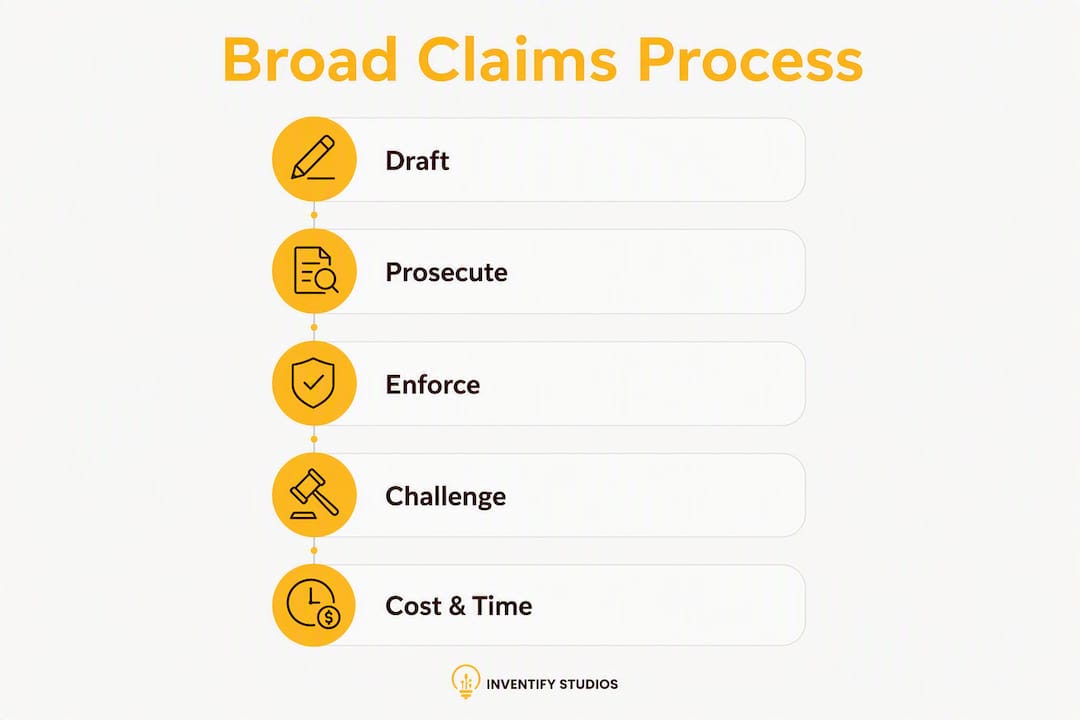
The USPTO applies the broadest reasonable interpretation (BRI) standard during examination, meaning examiners read your claims as broadly as the specification allows. That standard is intentional: it forces applicants to either narrow claims or expand their specification to support broad language. For inventors, it means a claim you think is precise may be read far wider than intended.
Broader claims at publication take significantly more time to examine and generate more office actions. The most common rejection grounds tied to breadth are:
- §102 anticipation: A single prior-art reference that discloses every element of your claim invalidates it. Broad claims sweep in more prior art.
- §103 obviousness: Even without a single anticipating reference, an examiner can combine two references to reject a broad claim.
- §112 enablement and written description: Under 35 U.S.C. §112, your specification must enable a person skilled in the art to practice the full scope of the claim. The Supreme Court's 2023 decision in Amgen v. Sanofi reinforced this: Amgen's broad functional antibody claims were invalidated because the specification did not enable the full genus. Broader claims demand richer specifications.
- §101 patent eligibility: Under Alice Corp. v. CLS Bank, abstract ideas implemented on a computer are not patentable. Broad functional software claims are frequent §101 targets.
- Indefiniteness: Vague functional terms without structural anchors invite indefiniteness rejections under §112(b).
Industry data indicates a correlation between multiple office actions during prosecution and a higher later invalidation rate in litigation. Patents that survive heavy prosecution amendment often end up with narrowed claims that were not the original strategic intent.
Practical mitigation during prosecution: use structural language where possible, include representative examples in the specification before filing, and have fallback dependent claims ready so amendments do not gut your coverage.
US practice does allow claims broader than the specific examples in your specification, but claims must still be supported and enabled by the disclosure. The European Patent Office and China's CNIPA apply tighter literal-support requirements, so inventors with international ambitions need to plan specification depth accordingly.

How do broad claims hold up in enforcement and post-grant challenges?
A granted broad claim is not the end of the story. It is often the beginning of a new set of risks. Competitors who receive a demand letter or notice of infringement have strong incentives to challenge your patent's validity, and broad claims give them more ammunition.
The primary post-grant attack paths in the US are:
- Inter Partes Review (IPR): — The USPTO's Patent Trial and Appeal Board (PTAB) reviews granted patents on §102 and §103 grounds. Broad claims with thin prior-art clearance are frequent IPR targets, and PTAB institution rates for petitions remain substantial.
Broad claims increase exposure to invalidation for lack of enablement or written description under §112 and to abstract-idea challenges under §101. The practical consequence: if your single broad independent claim falls in IPR, and you have no dependent claims left standing, you lose all protection. That is the all-or-nothing scenario every inventor should plan to avoid.
Pro Tip: Draft at least 8–12 dependent claims that each add a specific structural or functional limitation. If the independent claim is invalidated in IPR or litigation, dependent claims with different limitations can survive as independent claims through a reissue or continuation, preserving some protection.
Industry data shows a correlation between patents that received multiple office actions during prosecution and higher invalidation rates in later litigation. The connection is not causal in every case, but the pattern is consistent enough to treat heavy prosecution as a risk signal worth managing.
What do broad claims cost you in time and money?
Pursuing broad protection is not free, and the costs compound at every stage. Here is where the budget goes:
- Office-action responses: — Each USPTO rejection costs attorney time to respond. Broad claims typically generate more rounds.
| Claim approach | Typical office actions | Prosecution timeline | Relative cost |
|---|---|---|---|
| Narrower independent claim | 1–2 | 18 months | Lower |
| Calibrated broad claim (layered) | 2–3 | — | Moderate |
| Aggressively broad functional claim | 3+ | — | Higher |
Portfolio redesigns using layered claim strategies have reported reductions such as 27% fewer office actions and an 11-month shorter prosecution timeline, which translates directly into lower prosecution fees and faster grant.
The business tradeoff is real. A narrower claim may grant in 18 months at lower cost, but it gives competitors more room to design around. A calibrated broad approach costs more upfront and takes longer, yet it delivers better licensing scope and stronger deterrence. For budget-conscious inventors, an effective strategy is exploring funding options such as Funding Your MVP with the R&D Tax Incentive, which can help support prototyping and specification development stages to spread costs while preserving priority.
How do you draft claims that are broad but defensible?
The layered-claim framework is the practical standard for balancing reach with enforceability. Here is how to build it:
- Start with one calibrated independent claim. Write it broadly enough to cover the core inventive concept, but anchor it to at least one structural or functional element that distinguishes it from known prior art. Avoid purely functional language like "a device that improves efficiency" with no structural definition.
- Add 8–12 dependent claims that narrow incrementally. Each dependent claim should add one specific limitation: a material, a dimension range, a process step, or a specific configuration. These are your fallback positions if the independent claim is challenged.
- Prefer structural language over purely functional language. A claim that recites "a valve comprising a spring-loaded piston with a 2mm orifice" is harder to invalidate for lack of enablement than "a valve configured to regulate flow." Structural language ties the claim to your disclosed embodiment while still covering variants.
- Document embodiments during product development. Every prototype iteration, design variation, and test configuration is a potential representative species that can support a broader genus claim in your specification.
- Write representative species into the specification before filing. If you claim a genus (a broad category), the specification must describe enough species (specific examples) to show you actually invented across the full scope.
The difference between an overly broad claim and a defensible one often comes down to a single structural anchor. Consider: "A system for processing data" versus "A system for processing data comprising a processor configured to execute a lookup algorithm against a local hash table." The second version is still broad, but it is anchored to disclosed structure.
Pro Tip: Before filing, map each element of your independent claim back to a specific paragraph or figure in your specification. If you cannot find the support, add it. This exercise catches enablement gaps before the examiner does.

Claim drafting guidelines for inventors consistently recommend this specification-first approach: build the disclosure, then write claims to match it, not the other way around.
What are the red flags that a claim is too broad?
Not every broad claim is a good claim. These warning signs indicate your scope has crossed from ambitious into risky:
- Claim scope exceeds disclosed embodiments. If your independent claim covers 50 variations but your specification describes only one, you have an enablement problem waiting to happen.
- Purely functional language with no structural anchor. Terms like "configured to optimize," "adapted to improve," or "means for processing" without structural definition invite §112 indefiniteness rejections and §101 abstract-idea challenges.
- Multiple prior-art hits at the independent claim level. If a basic Google Patents search returns three or more references that appear to anticipate your broadest claim, the claim is likely too broad to survive examination.
- Undue experimentation required to practice the full scope. If a skilled practitioner would need to run extensive experiments to make the invention work across the full claim range, the claim fails the enablement standard.
- Word count of the independent claim is under 15 words. Very short independent claims are often a sign of excessive functional breadth. A claim like "A method of communicating information" has essentially no limiting language.
When several of these flags appear together, your options are: add dependent claims immediately to create fallback positions, expand the specification with additional representative examples before filing, or accept a narrower independent claim that you can actually defend. Identifying patentable subject matter early also helps you avoid claim language that sweeps in unpatentable concepts from the start.
What questions should you bring to counsel when deciding claim scope?
Use this checklist before your next counsel conversation. Group your priorities by business goal, then let the answers drive your claim posture.
- If your goal is maximum licensing value: Ask counsel to draft the broadest independent claim the prior art allows, confirm the specification enables the full scope, and request a prior-art breadth report covering at least three international databases.
- If your goal is speed to grant: Ask for a narrower independent claim with tight structural language, fewer functional terms, and a prior-art search focused on the most crowded subclass. Expect fewer office actions and a faster allowance.
- If your goal is minimum litigation risk: Ask for a claim set where every independent claim element maps to a specific disclosed embodiment, request a freedom-to-operate opinion alongside prosecution, and confirm that dependent claims cover your actual product configuration.
- Weigh prior-art density against your budget. A crowded field with dense prior art means broad claims will face more rejections and cost more to prosecute. A less crowded field may justify the investment in broader scope.
- Request three specific deliverables from counsel or your IP platform: a prior-art breadth report, a representative-species mapping (which disclosed examples support which claim elements), and a draft set of fallback dependent claims before the independent claim is finalized.
- Align claim scope with your product roadmap. If your product will evolve significantly in the next three years, broader claims capture that evolution. If your product is fixed, narrower claims may grant faster and cost less to defend.
For founders managing filings with limited counsel involvement, a DIY patent strategy guide can help you structure these questions before you pay for attorney time.
Key Takeaways
Broad patent claims expand market reach but require a layered, specification-backed claim strategy to remain defensible through prosecution, enforcement, and post-grant challenges.
| Point | Details |
|---|---|
| Scope is a strategic dial | Calibrate breadth against prior-art density and your business goal, not toward maximum width. |
| Layered claims are the standard | Recommended practice is pairing one calibrated broad independent claim with 8–12 narrowing dependent claims to optimize market coverage and patent stability. |
| Budget for the full cycle | Broad claims generate more office actions and longer prosecution; portfolio redesigns using layered claim strategies have reported reductions such as 27% fewer office actions and an 11-month shorter prosecution timeline. |
| Specification must match scope | Every element of a broad claim needs enabling disclosure; Amgen v. Sanofi shows courts will invalidate claims the spec cannot support. |
| Inventifystudios accelerates the process | The platform's prior-art search, claim-drafting guidance, and provisional drafting tools help inventors build specification-backed claims before filing. |
The part most inventors get wrong about broad claims
There is a persistent belief that the broadest possible claim is always the most valuable. It is not. A claim so broad it cannot survive a competent IPR petition is not an asset. It is a liability with a filing fee attached.
The more useful mental model: think of your independent claim as the outer boundary of a territory you can actually defend. If you cannot draw a line around that territory in your specification, with real examples and enabled disclosure, you do not own it. You are just asserting it.
What most inventors underestimate is the specification's role. Claim drafting gets most of the attention, but the specification is where enforceability is built or lost. A rich specification with multiple representative embodiments, documented variations, and clear structural descriptions gives you the foundation to support broad claims and survive challenges. Skimping on specification depth to save drafting time is one of the most expensive shortcuts in patent practice.
The other thing worth saying plainly: some practitioners will tell you that broader is always better because it generates more prosecution work and higher fees. That is a real dynamic in the industry. Your interest is an investment-grade patent that aligns with your long-term business goals, not an extended prosecution cycle. Know the difference before you sign an engagement letter.
Inventifystudios gives inventors a faster path to defensible claims
Filing a patent with broad, specification-backed claims used to mean weeks of attorney time and thousands of dollars before you even reached the USPTO. Inventifystudios cuts that gap significantly.
The platform's automated prior-art breadth reports surface competing claims across USPTO and international databases before you file, so you calibrate scope based on real data, not guesswork. The claim-drafting guidance walks you through layered independent and dependent claim structures, and the provisional patent drafting tools help you capture representative embodiments from your prototype work directly into your specification. That means the disclosure backing your broad claims is built as you develop the invention, not retrofitted after the fact.
For inventors who want hands-on help structuring their claim strategy, the Invention Detail page shows exactly how the platform supports each stage from prior-art search through provisional filing. Final legal review should always involve a registered patent attorney or agent, and Inventifystudios is designed to make that counsel time more productive, not replace it.
Useful sources and further reading
- USPTO — Broadest Reasonable Interpretation Standard (MPEP §2111): The primary USPTO guidance on how examiners interpret claim scope during prosecution.
- 35 U.S.C. §112 — Specification requirements (Cornell LII): The statutory text governing enablement, written description, and definiteness.
- 35 U.S.C. §101 — Patent eligibility (Cornell LII): The statutory basis for abstract-idea and subject-matter eligibility challenges.
- Amgen Inc. v. Sanofi — Supreme Court opinion: The 2023 decision reinforcing enablement limits on broad functional claims.
- USPTO — Inter Partes Review: Official guidance on the IPR process and PTAB proceedings.
- USPTO — General information concerning patents: Foundational USPTO resource for inventors new to the filing process.
- Patent Claim Scope Analysis: The Beginner's Guide to Enforceability and Value (GIP Research): Practical analysis of layered claim strategies, prosecution outcomes, and portfolio redesign data.
- The Perils of Broad Patent Claims: From Issuance to Invalidity (IPFDA Law): Detailed review of §112 and §101 risks for broad claims.
- Patent Application Drafting for Broad and Narrow Claims (RBI P Law): Practitioner guidance on balancing independent and dependent claim scope.
- The Importance of Getting Claim Scope Right in a US Patent Application (Rimon Law): US vs. international comparison of claim-support requirements.
- Invention Claim Drafting Guidelines for Inventors (Inventifystudios Blog): Practical drafting pointers tailored to independent inventors and early-stage founders.