

Democratizing invention is defined as expanding equal access to the tools, processes, and opportunities that allow anyone to contribute meaningfully to innovation. Right now, that access is deeply unequal. Over 50% of U.S. patents come from just 10 geographic areas, and women account for only 17% of inventors nationwide. That concentration means the world is solving problems with a fraction of its available talent. Inclusive invention, the formal term for this practice, corrects that imbalance by bringing more voices, more lived experiences, and more problem types into the innovation process. Inventifystudios was built on exactly this premise: that great ideas do not belong to a privileged few.
Why democratizing invention matters for equal participation
Innovation in the United States is not evenly distributed. It clusters in specific cities, industries, and demographic groups, which means entire categories of problems go unsolved because the people who experience them are not in the room where inventions get made.
The numbers make this concrete. Women inventors rise to 26% in university settings, compared to 17% in the broader patent system. That 9-point gap shows that structured, visible environments increase participation. Education creates the conditions that the broader market has not yet replicated.

| Inventor group | Share of U.S. patents |
|---|---|
| Women (national average) | 17% |
| Women (university settings) | 26% |
| Patents from top 10 geographic areas | Over 50% |
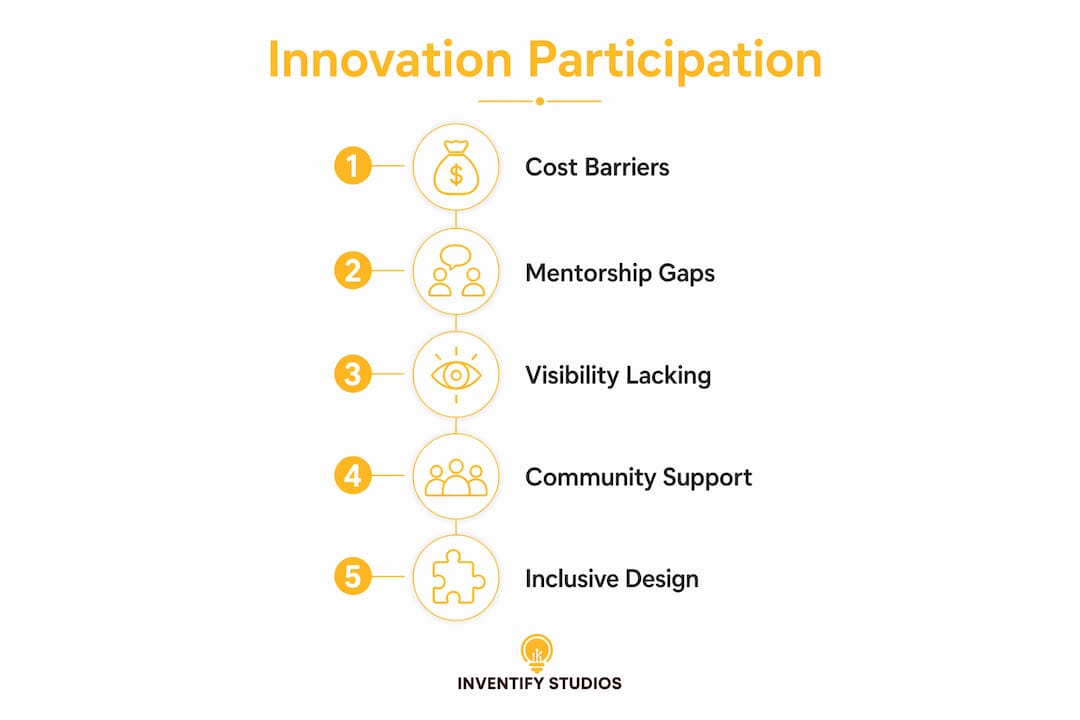
Three barriers consistently limit broader participation in invention: cost of prototyping and patent filing, lack of mentorship networks, and low visibility of the invention process itself. Making innovation processes visible is a documented factor in increasing engagement from historically underrepresented groups, particularly women. Transparency is not a soft benefit. It is a structural lever.
Pro Tip: If your organization runs an internal innovation program, publish the names of past inventors and the problems they solved. Visibility alone shifts who believes they belong in the process.
Educational institutions have a proven track record of closing the participation gap. Universities that actively promote patent clinics, invention disclosure programs, and faculty-led mentorship see measurably higher inventor diversity. The lesson for organizations is direct: structure and visibility produce inclusion, while informal networks reproduce existing demographics.
How lead users and peer communities drive accessible innovation
Commercially significant innovation most often originates from lead users solving unmet needs, not from internal R&D departments working from aggregate market data. A lead user is someone who experiences a problem before the mainstream market does and builds a workaround because no product yet exists. That workaround frequently becomes the next product category.
This matters for the importance of accessible innovation because lead users are rarely found inside large corporations. They are nurses adapting medical equipment, athletes modifying gear, and small-business owners building tools their industry does not yet sell. Connecting these creators to prototyping resources and patent knowledge is what turns their workarounds into protected, scalable inventions.
The internet has fundamentally changed the economics of this process. Internet diffusion cuts the cost of peer-to-peer innovation sharing, making user communities competitive with internal R&D in speed and market relevance. A community of 10,000 users sharing design files, testing feedback, and patent-filing tips can outpace a corporate lab that moves through formal approval cycles.
The role of community in invention is not incidental. It is structural. Consider these documented advantages of peer-driven innovation networks:
- Faster iteration: Community members test and refine ideas in real conditions, not controlled labs.
- Broader problem coverage: Distributed inventors tackle niche problems that large R&D teams deprioritize.
- Lower diffusion costs: Digital platforms allow innovations to spread globally at near-zero marginal cost.
- Better market signals: Edge case users yield stronger foresight than aggregate consumer surveys.
Statistic: Women hold only 17% of U.S. patents nationally, yet represent 26% of university inventors. That gap closes when access to resources and visibility increases.
Platforms that support online inventor communities accelerate this dynamic. When inventors can share prototypes, compare patent strategies, and co-develop ideas, the output quality rises and the barriers to entry fall. This is the practical engine of invention democratization.
How does inclusive design improve invention for everyone?
Inclusive design is the practice of building products and systems with people who face barriers, not just for them. That distinction changes everything about the output.
The most cited example is the curb cut. Sidewalk ramps were mandated in the United States for wheelchair users. Within years, parents with strollers, delivery workers with hand trucks, and cyclists all relied on them daily. The curb-cut effect shows that designing with users facing barriers produces universally adaptive innovations, not niche accommodations. The same pattern holds for closed captions, which were created for deaf viewers and are now used by millions in noisy environments, and for voice recognition, which was developed for users with motor impairments and is now the default interface on billions of devices.
Inclusive design follows a clear process when done well:
- Identify the barrier. Define the specific friction a user group experiences, not a general accessibility goal.
- Recruit active partners. Bring users facing that barrier into the design process as co-creators, not test subjects.
- Prototype with constraints. Build solutions that work under the most restrictive conditions first.
- Test for universal benefit. Measure whether the solution improves usability for users who do not face the original barrier.
- Document and share. Publish the design logic so other inventors can build on it.
Accessibility-driven invention creates products that are more usable, more marketable, and more resilient under pressure. Designing from inception around human needs produces technology that outperforms designs built for an assumed average user. This is not a compliance argument. It is a performance argument.
Pro Tip: When scoping a new invention, write a one-sentence description of the user who faces the most friction with the current solution. Design for that person first. The broader market will follow.
The benefits of inclusive invention extend beyond product quality. Inclusive design demands engaging those facing barriers as active partners, which builds more resilient systems. During the COVID-19 crisis, organizations with inclusive design practices adapted faster because their products and workflows were already built to handle constraint and variability.
What are the organizational and societal impacts of democratized invention?
Democratized invention changes how organizations operate internally, not just what products they release externally. The evidence comes from research on disability-inclusive job design, which serves as a precise test case for what happens when invention processes accommodate diverse needs.
Designing with people with disabilities uncovers workflow inefficiencies and improves team collaboration. Research across 14 projects found that structured accommodation processes reduce errors and improve knowledge sharing across entire teams, not just for the individuals being accommodated. That finding has a direct implication: the act of making a process accessible forces organizations to document it, and documentation reduces cognitive load for everyone.
The organizational benefits of inclusive invention ecosystems include:
- Documented workflows: Accommodations require written processes, which reduce ambiguity for all team members.
- Reduced errors: Structured processes improve knowledge sharing and cut mistakes across teams.
- Stronger collaboration: Inclusive teams surface disagreements earlier and resolve them more effectively.
- Better retention: Inventors who see their backgrounds reflected in a team's work stay longer and contribute more.
The societal impact scales these organizational gains. When invention access expands to underrepresented groups, the problems those groups experience get solved. Medical devices designed with input from patients in low-resource settings work better in those settings. Agricultural tools designed with smallholder farmers outperform tools designed in urban labs. The innovation workflow that includes diverse creators produces outputs that serve diverse markets.
| Impact area | Mechanism | Outcome |
|---|---|---|
| Workforce productivity | Documented, inclusive processes | Fewer errors, faster onboarding |
| Market reach | Diverse inventor input | Products that serve underserved segments |
| Economic equity | Broader patent participation | Wealth creation outside traditional hubs |
| Crisis resilience | Inclusive design practices | Faster adaptation under constraint |
The economic argument for why innovation should be inclusive is not abstract. Concentrating invention in 10 geographic areas and among a narrow demographic means the remaining potential sits idle. Expanding that base is not charity. It is efficiency.
Key Takeaways
Democratizing invention is the single most direct path to closing the gap between the problems the world faces and the talent available to solve them.
| Point | Details |
|---|---|
| Patent concentration is a solvable problem | Over 50% of U.S. patents come from 10 areas, but university programs show that structured access closes the gap. |
| Lead users drive real innovation | Users solving their own unmet needs produce stronger market signals than internal R&D working from aggregate data. |
| Inclusive design benefits everyone | The curb-cut effect proves that designing for users facing barriers creates products the broader market adopts widely. |
| Visibility increases participation | Making innovation processes transparent is a documented lever for increasing engagement from underrepresented groups. |
| Organizational gains are measurable | Inclusive job design across 14 projects reduced errors and improved collaboration for entire teams, not just accommodated individuals. |
The overlooked cost of keeping invention exclusive
Most conversations about invention democratization focus on fairness. That framing is correct, but it undersells the argument. The real cost of concentrated invention is not inequality. It is lost solutions.
Every inventor who cannot access prototyping tools, patent guidance, or a community of peers represents a problem that does not get solved. That problem might be a medical device, a farming tool, a communication aid, or a safety system. The person best positioned to solve it is often the person who experiences it daily, and that person is frequently outside the traditional innovation pipeline.
What I find most striking is how low the barrier to entry actually needs to be. The research on lead users shows that people already create workarounds without any institutional support. They are inventing anyway. The question is whether those inventions get protected, refined, and brought to market, or whether they stay as informal fixes that help one person and disappear.
AI-powered tools that generate 3D prototypes, analyze patentability, and draft provisional patent language change this equation directly. They do not replace expertise. They make expertise accessible at a price point that does not require a corporate budget. The role of AI in invention is not to automate creativity. It is to remove the administrative and financial walls that stop creative people from acting on their ideas.
The organizations that build inclusive invention practices now will have a structural advantage. They will see problems earlier, through the eyes of edge-case users. They will build products that work under constraint. And they will retain inventors who feel their perspective is part of the process, not an afterthought.
— Hua
Inventifystudios and the future of accessible invention
Inventifystudios was built to put professional-grade invention tools in the hands of every creator, regardless of budget or background.

The platform gives inventors access to an AI prototype generator, patentability analysis, and provisional patent drafting, all without the fees that traditional consulting services charge. A first-time inventor can build and validate an idea in the same session, moving from concept to patent-ready documentation without needing a law firm or a corporate R&D team. Inventifystudios also supports self-guided invention at every stage, so creators with no prior experience can move at their own pace. The goal is simple: remove the cost and complexity that keep good ideas from becoming real inventions.
FAQ
Why does democratizing invention matter economically?
Concentrating invention in a small number of geographic areas and demographic groups leaves enormous problem-solving potential unused. Expanding access creates new markets, new patents, and new economic activity outside traditional innovation hubs.
What is the curb-cut effect in invention?
The curb-cut effect describes how designs created for users facing barriers, such as wheelchair ramps or closed captions, end up benefiting the broader population. It is the clearest evidence that inclusive design produces universally better products.
Who are lead users and why do they matter?
Lead users are people who experience a problem before the mainstream market does and build their own solutions. Research shows they produce stronger innovation signals than internal R&D teams working from aggregate consumer data.
How does making innovation visible increase participation?
Transparency in the innovation process, such as publishing inventor names and patent outcomes, is a documented factor in increasing engagement from underrepresented groups. Women's inventor rates rise from 17% to 26% in university settings where processes are structured and visible.
Can small organizations benefit from inclusive invention practices?
Structured, inclusive processes reduce errors and improve knowledge sharing across teams of any size. Research on 14 projects found that accommodating diverse needs produces documented workflows that lower cognitive load for all team members.