
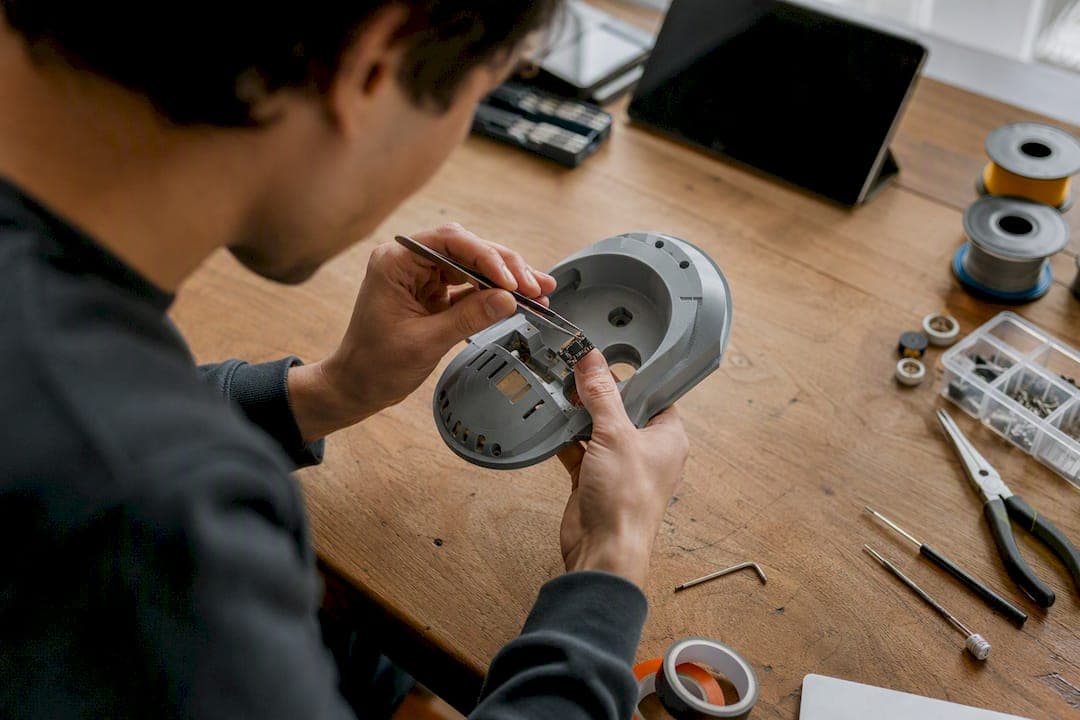
A prototype turns your pitch from a promise into proof, and proof is what moves investors from interested to committed. When a founder hands over an idea alone, an investor has to imagine the product working. When a founder hands over a prototype, the investor experiences it.
That shift matters because it does two things at once:
- It demonstrates execution capability. You built something real, on a timeline, with limited resources.
- It reduces technical and delivery risk. Investors stop guessing whether the thing can be made and start asking how big it can get.
An interactive prototype creates what researchers call a "visceral connection," pulling investors from passive listening into active participation. Platforms like Inventifystudios exist precisely because that shift, from told to shown, is the single biggest lever founders have in a pitch.
Key Takeaways
Prototypes raise investor conviction because they convert assumptions into tested evidence, and matching fidelity to your funding stage prevents wasted time and budget.
| Point | Details |
|---|---|
| Prototypes shift investor questioning | Interactivity moves conversations from feasibility doubts to scaling and economics questions. |
| Match fidelity to the ask | Build only enough prototype to answer the next specific investor objection. |
| Package evidence tightly | Combine a demo, test results, a BOM snapshot, and a roadmap into one short appendix. |
| Rehearse for failure | Always prepare a backup demo video and disclose mocked elements upfront. |
| Feedback is a diligence tool | Log patterns across investor demos and visibly close the loop in follow-up meetings. |
Table of Contents
- Why Prototypes Matter for Investor Pitches: The Behavioral Shift
- What Investors Actually Look For in a Prototype
- Matching Prototype Fidelity to Your Funding Stage
- Building the Demo and Pitch Assets That Investors Trust
- How Much Prototyping Should Cost You Before a Raise
- Common Demo Mistakes That Undermine Investor Trust
- How Inventify Studios Helps Founders Build Investor-Ready Prototypes
- How Prototypes Reduce Investor Risk by Validating Assumptions
- The Role of Prototypes in Storytelling and Emotional Engagement
- Turning Investor Feedback From Prototype Demos Into Progress
- Pitches That Prototypes Actually Won
- Boost Your Next Pitch With an Investor-Ready Prototype
- What Founders Consistently Get Wrong About Prototypes
- Frequently Asked Questions
- Sources
Why Prototypes Matter for Investor Pitches: The Behavioral Shift
Investors do not fund ideas. They fund evidence that an idea can become a business, and a prototype is the fastest way to supply that evidence. The mechanism is less about the object itself and more about what it does to the conversation in the room.
When an investor can tap through a screen, turn a physical part in their hands, or watch a feature actually fire, their brain stops treating the pitch as a hypothetical. They stop asking "could this work?" and start asking "how fast can this scale?" That is a fundamentally different, and far more productive, line of questioning for a founder to be on the receiving end of.
There is a hard financial logic underneath this too. Catching design flaws during prototyping costs a fraction of what it costs to discover the same flaws after full-scale development, according to Autodesk's research on product design workflows. Investors know this. A founder who shows up with a tested prototype is implicitly showing that they have already absorbed the cheap mistakes, so the investor's capital is going toward growth, not toward paying for a first draft.
A prototype gives investors a shared reference point. Instead of debating whose mental image of the product is correct, everyone in the room is reacting to the same object, the same screen, the same test result.
That shared reference point shortens diligence cycles. Feasibility questions get answered on the spot instead of dragging into a second or third meeting, which means the conversation shifts sooner toward the questions that actually determine deal size: market size, margins, and defensibility.
What Investors Actually Look For in a Prototype
Not every prototype earns its keep in a pitch. The ones that move a term sheet forward answer a specific investor concern, not just "does it look nice." Here are the signals experienced investors are actually screening for:
- Feasibility — can this physically or technically be built at the claimed cost and timeline? Test results and a draft bill of materials answer this directly.
- Desirability — does anyone actually want it? Letters of intent, pre-orders, or user test recordings are the strongest evidence here.
- Unit economics — will it make money per unit sold? A COGS estimate tied to your prototype's actual materials list carries more weight than a spreadsheet assumption.
- Manufacturability — can it be produced at volume, not just as a one-off? Engineering-stage prototypes or DFM (design for manufacturability) notes address this.
- Early traction — pilot metrics, waitlist numbers, or usage data from a limited release.
Package this evidence as a short appendix, not a wall of text in the main deck. A one-page "evidence summary" slide with test results, a BOM snapshot, and a pilot metric or two lets an investor absorb your proof points in under a minute.
Pro Tip: Rank your evidence by which investor objection it kills fastest. If everyone asks "can you actually build this," lead with your feasibility test results, not your market size slide.
Matching Prototype Fidelity to Your Funding Stage
The fidelity you need depends entirely on what decision you're trying to move, not on what looks most impressive. A wireframe you can tap through will outperform a static mockup when the goal is communicating a flow to a decision-maker, according to Miro's guidance on prototype fidelity. Polish rarely wins pitches. Interactivity does.
Here is a rough map of fidelity tiers against the funding conversation they're built for:
- Sketch or wireframe — idea and pre-seed conversations, answering "do you understand the problem?"
- Clickable prototype — angel and early seed rounds, answering "does the experience make sense?"
- Works-like prototype — seed and early Series A, answering "does the core function actually perform?"
- Engineering or DFM prototype — later Series A and beyond, answering "can this be manufactured at scale?"
- Physical preproduction unit — growth-stage or hardware-heavy rounds, answering "is this ready for customers?"
The practical rule: invest in higher fidelity only when you're closing a larger round or need to prove manufacturability specifically, as showcased in the Custom Software Portfolio at Let's Build My App. A clickable prototype built in a modern tool can change stakeholder conversations from abstract to concrete almost overnight, and it costs far less than jumping straight to an engineering build you don't yet need.
Building the Demo and Pitch Assets That Investors Trust
A strong demo isn't a single moment, it's a sequence of assets that let an investor verify your claims without asking you to repeat yourself. Build this checklist before you build your slide deck:
- A live, working prototype, clickable or works-like, that responds to real input.
- A two to three minute backup demo video, recorded in advance, in case the live version fails.
- A one-page summary of test results relevant to your core claims.
- A BOM or COGS snapshot showing your cost assumptions are grounded in something real.
- A short roadmap and risk register naming what's left to solve and how you'll solve it.
A practical demo plan built around a demo video, test results, a BOM, and a clear roadmap helps investors move through diligence faster, according to Funded's fundraising research. Narrate the demo in this order: tell the user story first, show the live experience second, back it with quantitative evidence third, and close with a specific milestone ask.
Pro Tip: Label every mocked or simulated element out loud during the demo. Investors forgive a mock. They don't forgive discovering one later that you didn't mention.
How Much Prototyping Should Cost You Before a Raise
Timelines scale directly with fidelity. A clickable prototype in a tool like Figma can be built in days. A works-like prototype typically takes several weeks of iteration. An engineering-grade or DFM prototype often runs into months, especially for hardware, because tooling and testing cycles are inherently slower than software sprints.
Budget in these rough buckets:
- Design and prototyping software subscriptions, usually the smallest line item.
- Fabrication costs, like 3D printing runs or short-batch manufacturing.
- Engineering or lab time if your product involves electronics, mechanics, or materials testing.
- Contractor or freelance design fees for anything outside your own skill set.
- Testing costs, including any user research or pilot program expenses.
The prioritization rule is simple: spend only to answer the next question your target investor will ask. If a Figma prototype answers it, don't commission an engineering build. Reducing avoidable revision cycles by testing cheap and early is the single biggest lever you have over your prototyping budget.
Common Demo Mistakes That Undermine Investor Trust
Founders lose credibility in the demo far more often than in the slides. The most frequent errors are over-polishing a prototype so it looks more finished than it is, hiding which parts are mocked, running a live demo with no backup, and burying nontechnical investors in engineering detail they can't evaluate.
The fixes are straightforward:
- Disclose mocked or simulated elements before an investor has to ask.
- Always have a recorded backup ready, and rehearse switching to it without breaking your narrative.
- Run a full rehearsal specifically testing failure modes, not just the happy path.
- Talk about the value story, not your internal architecture, unless asked.
Investors notice red flags fast: claims in your deck that don't match what the demo actually shows, or a technical claim with no supporting evidence anywhere in your materials.
Pro Tip: If your prototype might fail live, say so before you start. "This is a beta build, so bear with me" earns more trust than a crash you didn't warn anyone about.
How Inventify Studios Helps Founders Build Investor-Ready Prototypes
Founders without a design or engineering background face the steepest climb here, and that's the exact gap Inventifystudios is built to close. The platform's AI-powered 3D prototype generator lets you produce a visual, demoable concept in minutes rather than weeks, which directly serves the feasibility signal investors are screening for. Its patentability analysis tools give you an early read on defensibility, a factor investors increasingly ask about before committing. And its provisional patent drafting guidance helps you move toward protection without the upfront cost of traditional patent counsel.
- AI 3D prototype generator → feeds the feasibility and desirability signals investors want to see fast.
- Patentability analysis → addresses defensibility questions before they're asked.
- Provisional patent drafting insights → supports the "protect what you've built" conversation.
A practical workflow: generate a rapid AI prototype, run a small desirability test with target users, then produce a short demo video and BOM snapshot from what you've learned.
Founders who show iterative improvement, a rough version now, an improved one weeks later, signal execution discipline that raises investor confidence.
| Approach | Time to First Demo | Typical Cost Signal |
|---|---|---|
| Traditional design consultancy | Weeks to months | High upfront fees |
| DIY without tools | Highly variable | Low cash cost, high time cost |
| Inventifystudios AI prototype generator | Minutes to hours | Low, subscription-based |
Pro Tip: Use your first AI-generated prototype as a conversation starter with five target users before you ever put it in front of an investor. Their feedback becomes your desirability evidence.
How Prototypes Reduce Investor Risk by Validating Assumptions
Every pitch is built on assumptions: that the product works, that people want it, that it can be made at a viable cost. A prototype doesn't eliminate those assumptions, but it converts the shakiest ones into tested claims, and that's exactly what lowers an investor's perceived risk.
Consider the difference between saying "customers will pay $40 for this" and showing pre-orders collected against a working prototype at that price point. The first is a guess dressed up as a forecast. The second is data. Investors are trained to discount forecasts and weight data heavily, so every assumption you can move from the first category to the second directly improves your odds.
This works for technical risk in the same way. A founder who claims a device will hit a certain battery life is making an assumption. A founder who shows a test log demonstrating that battery life on an actual unit has removed the risk entirely from that specific claim. Designers build prototypes specifically to test assumptions alongside checking function and validating desirability with real users, according to BYU's design research, and all three of those purposes map directly onto what an investor is quietly trying to verify during your pitch.
The founders who raise fastest aren't the ones with the fewest open questions. They're the ones who've already tested the questions that would have killed the deal.
The Role of Prototypes in Storytelling and Emotional Engagement
Numbers convince the analytical part of an investor's brain. A prototype convinces the rest of it. Pitches that lean only on market size slides and financial projections ask investors to do all the imaginative work themselves, and most won't do it well, or won't do it at all.
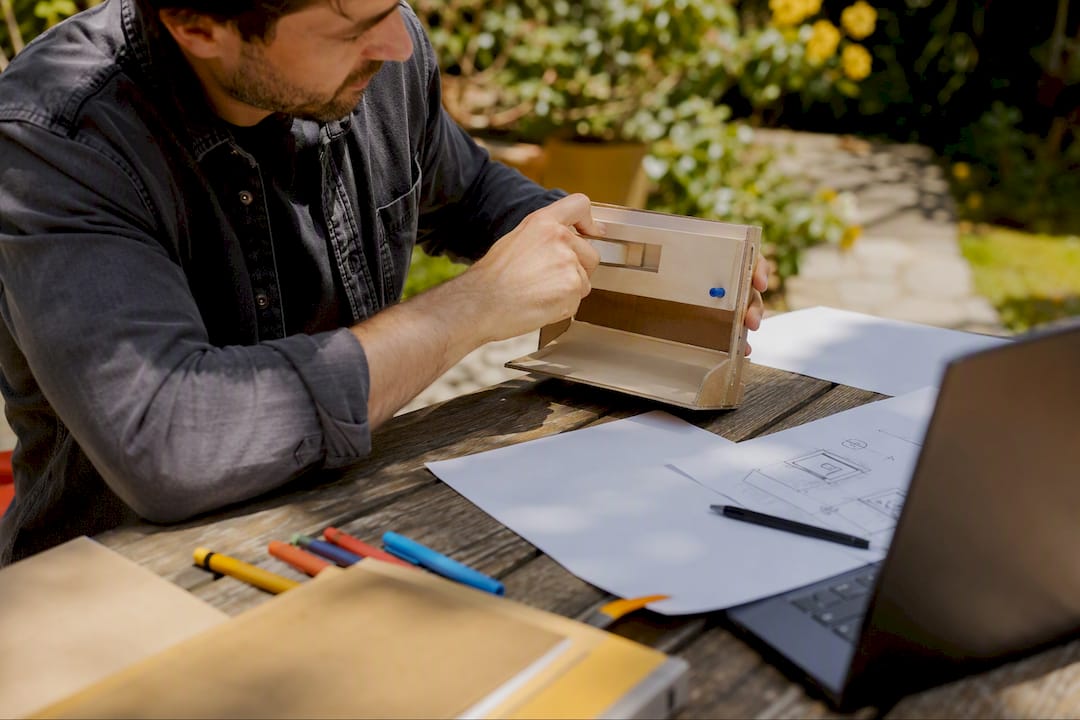
A prototype gives you something to build a story around instead of just a claim to defend. You can walk an investor through a real user scenario: here's the problem this person had, here's them using the actual product, here's what changed for them. That narrative arc, problem, product, outcome, is far more memorable than a bullet point, and memorable is what gets a deal discussed again after the meeting ends.
This emotional dimension isn't a soft add-on to the rational case, it's often what tips a genuinely undecided investor. Two founders can have identical market data and nearly identical products, and the one who let the investor physically interact with something real will usually be remembered more vividly a week later, when the investor is deciding which three pitches out of thirty to revisit. Prototyping as a mindset built for conversation, rather than final validation, is a principle design thinking practitioners have pushed for years, and it applies just as much to a fundraising meeting as it does to a product sprint.
Turning Investor Feedback From Prototype Demos Into Progress
The feedback you get during a prototype demo is worth more than feedback on a slide deck, because it's reacting to something specific rather than something abstract. The trick is capturing it in a form you can actually act on.
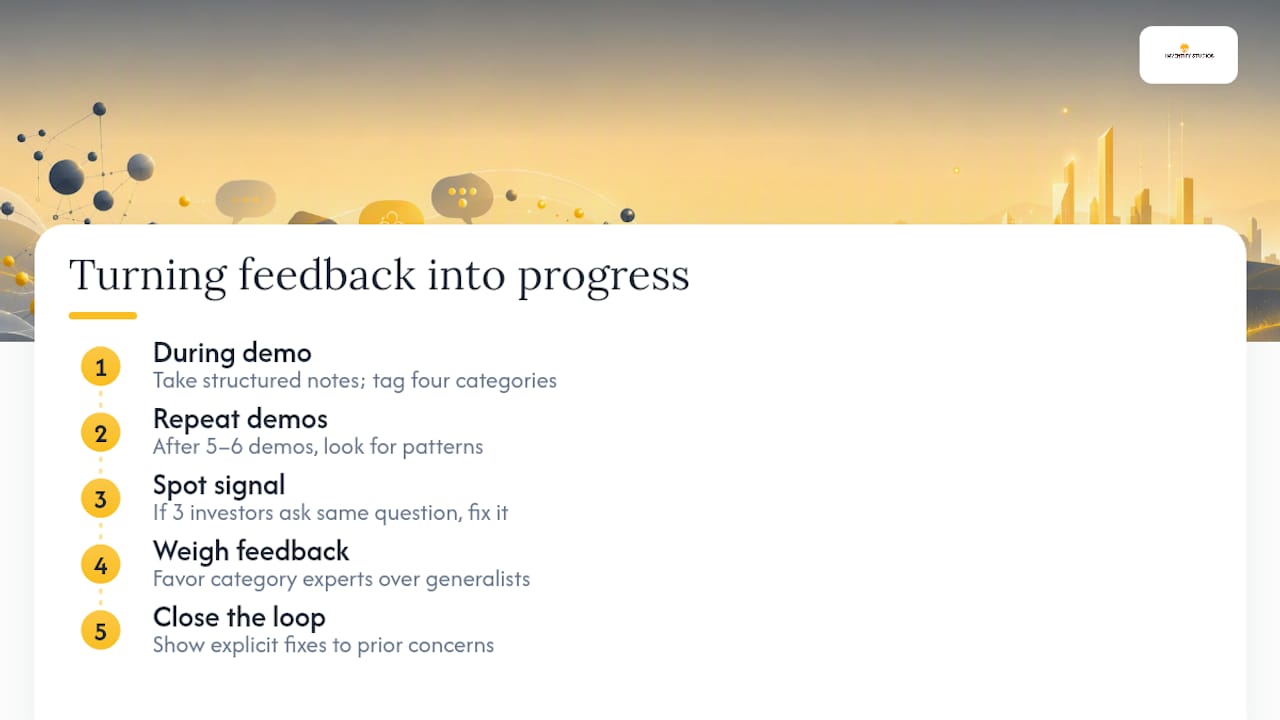
Take structured notes during every demo, tagged by category: feasibility doubts, desirability concerns, pricing pushback, and competitive comparisons. Patterns emerge fast once you've run the same demo past five or six investors. If three separate investors ask the same question about your unit economics, that's not noise, that's a gap in your evidence you need to close before the next round of meetings.
Close the loop visibly. If an investor raised a concern in meeting one, and you've addressed it by meeting two, say so explicitly: "You asked about manufacturing cost last time, here's the updated BOM." That single move does more for investor confidence than almost anything else in a follow-up conversation, because it shows you treat their scrutiny as useful input rather than an obstacle to route around.
Not all feedback deserves equal weight. An investor who's spent a career in your specific category is worth listening to closely. A generalist investor's aesthetic opinion on your prototype's interface is worth noting but not necessarily acting on. Learn to tell the difference early, so you're iterating toward the signal and not chasing every comment that comes your way.
Pitches That Prototypes Actually Won
The pattern across successful raises isn't a specific prototype technique, it's timing the right fidelity to the right ask. Founders who raised seed rounds off clickable prototypes typically weren't trying to prove manufacturability yet, they were proving the experience made sense, and a tappable flow answered that question completely.
Hardware founders tell a different version of the same story. A rough, ugly, working unit that demonstrates the core function beats a beautifully rendered concept video every time an investor is deciding whether the hard technical problem is actually solved. Investors have seen enough polished renderings that never shipped to be skeptical of visuals alone, and a working prototype, however unglamorous, cuts through that skepticism immediately.
The through-line in pitches that land funding is specificity: a demo that answers the exact question the investor was going to ask anyway, delivered before they have to ask it. That's not a matter of budget or design talent. It's a matter of knowing which single assumption is standing between your pitch and a yes, and building just enough prototype to remove it.
Boost Your Next Pitch With an Investor-Ready Prototype
You don't need a design team or a five-figure consulting budget to build a prototype that changes how investors respond to your pitch. Inventifystudios was built to close exactly that gap, combining an AI-powered 3D prototype generator with patentability analysis and provisional patent drafting guidance in one platform.
Start with the invention detail tools on Inventifystudios to move from concept to a demoable prototype without the traditional consulting price tag. Whether you're prepping for your first angel conversation or a Series A round, the right prototype, built at the right fidelity, is often the difference between a pitch that gets a follow-up meeting and one that doesn't.
What Founders Consistently Get Wrong About Prototypes
Most advice on this topic treats prototyping as a design exercise you complete once before fundraising starts. That's backwards. The founders who raise most efficiently treat the prototype as a living argument, built specifically to answer whatever objection is currently standing between them and their next check.
The overrated move is chasing visual polish. A beautifully rendered prototype that doesn't respond to touch or doesn't reflect real test data tells an investor almost nothing they couldn't get from a good illustrator. What actually moves conviction is interactivity paired with evidence, however unglamorous the build looks.
What the conventional advice underweights is sequencing. Build to the fidelity your next investor conversation requires, not the fidelity that would impress a room full of design peers. A clickable prototype that nails the user flow will outperform a half-finished engineering build every time the ask is about experience, not manufacturability.
If you take one thing from this: figure out the single question standing between you and your next yes, then build only enough prototype to answer it. Tools like Inventifystudios exist to compress that build time down to hours instead of months, which matters most when your runway is the thing actually running out.
Frequently Asked Questions
Why do prototypes matter for investor pitches specifically? Prototypes matter for investor pitches because they replace assumptions with evidence. An investor watching a working demo doesn't have to imagine whether your product functions, they see it, which shortens diligence and shifts the conversation toward growth potential.
Do I need a working prototype for a pre-seed pitch? Not usually. A sketch or clickable prototype is often sufficient at the pre-seed stage, since the primary question investors are asking is whether the concept and user flow make sense, not whether it can be manufactured at scale.
How much should a startup spend on a prototype before fundraising? Spend only enough to answer the next question your target investor will ask. A Figma or AI-generated clickable prototype can cost very little and take days, while an engineering-grade prototype for manufacturability proof can take months and a meaningfully larger budget.
What happens if my live demo fails during a pitch? Have a backup video ready and switch to it immediately without apologizing excessively. Investors generally respect founders who handle a technical hiccup calmly far more than they penalize the hiccup itself.
Can AI tools really replace a design team for early prototypes? For early-stage, investor-facing prototypes, AI tools like the generator built into Inventifystudios can produce a demoable 3D concept in minutes, which is often sufficient to test desirability and feasibility signals before committing to a full design build.
Sources
- From concept to capital: how prototypes can help fast-track funding | Forbes
- How much fidelity does your prototype need to win a pitch? | Miro
- How a working prototype can help attract investors | Funded