

Affordable invention feedback methods are defined as low-cost techniques that let inventors collect reliable market signals before spending money on patents or product development. The industry term for this practice is "lean validation," and it covers everything from fake door tests to pre-sale campaigns. Skipping this step is one of the most expensive mistakes an inventor can make. Patent filings should be based on validated concepts to prevent wasted costs and focus investment on commercially viable ideas. Inventifystudios exists precisely to close this gap, giving inventors structured tools to validate before they commit.
What are the most effective affordable invention feedback methods?
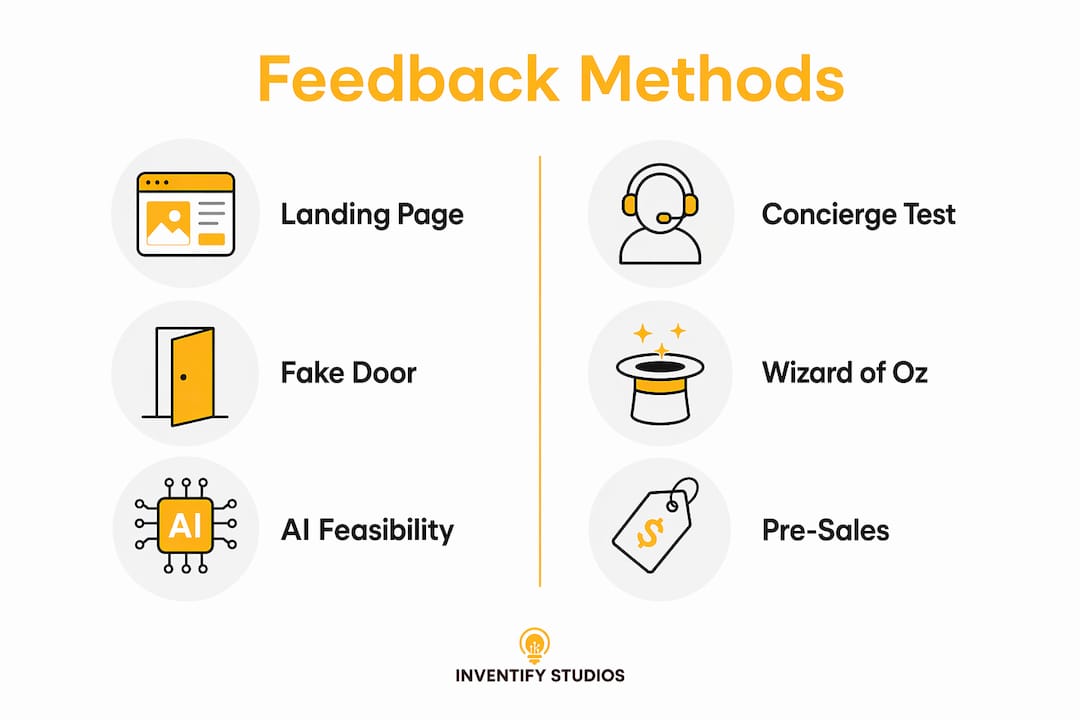
The highest-signal, lowest-cost feedback method is a landing page paired with a payment call to action. You build a one-page site describing your invention, add a Stripe Payment Link or Gumroad pre-order button, then drive paid traffic to it. Conversion under 2% after 1,000 visitors is a clear kill criterion. That test costs $150–$300 in ad spend, which is less than 2% of what a traditional agency charges for comparable research.
Fake door testing is a close cousin of the landing page method. You advertise a product that does not yet exist, then measure click-through and sign-up rates. The goal is not to deceive buyers permanently. You redirect anyone who clicks "Buy" to a waitlist page and explain the product is coming soon. The click rate tells you whether the problem resonates; the sign-up rate tells you whether people want your specific solution.

Concierge testing and Wizard of Oz prototypes address a different question: can you actually deliver this? Manual concierge testing validates operational risks before you build expensive automation. You fulfill orders by hand, using spreadsheets and phone calls instead of software, to confirm the workflow is viable. This saves thousands by catching operational failures before any engineering begins.
| Method | Estimated cost | Signal type | Best for |
|---|---|---|---|
| Landing page + paid ads | $150–$300 | Behavioral (clicks, payments) | Demand and willingness to pay |
| Pre-sale via Stripe or Gumroad | $0–$50 setup | Behavioral (actual payment) | Willingness to pay |
| Fake door test | $100–$250 in ads | Behavioral (click-through) | Demand and messaging fit |
| Concierge or Wizard of Oz | $0–$100 in time | Operational | Delivery feasibility |
| AI feasibility assessment | $0–$30 | Structured scoring | Technical and market red flags |
Pro Tip: Never rely on a single method. Triangulating four or five independent cheap signals gives you decision-grade confidence comparable to a single expensive study, as long as four out of five signals point the same direction.
How to choose the right method based on your invention's risk profile
Every invention carries a different mix of risks, and the right feedback method depends on which risk is largest. Choosing the wrong method wastes both time and money.
The four main risk categories are:
- Demand risk. Do enough people want this? Use landing page tests and fake door ads. These methods measure whether strangers will click, sign up, or pay, which is the only honest answer to a demand question.
- Willingness-to-pay risk. Will people pay your target price? Surveys overestimate willingness to pay by 2–4 times compared to actual payment behavior. Run a pre-sale test with a real price point instead.
- Operational risk. Can you build and deliver this reliably? Concierge testing and Wizard of Oz prototypes are the right tools. They expose workflow failures before you write a single line of code or file a manufacturing order.
- Channel risk. Can you reach your buyers affordably? Run small paid ad campaigns across two or three channels and compare cost per click. The channel with the lowest cost per engaged visitor is your answer.
B2B inventions carry an additional layer: the buyer and the user are often different people. For B2B ideas, add direct outreach to five to ten target companies and ask for a letter of intent or a paid pilot. A letter of intent from a real company is worth more than 500 survey responses.
Pro Tip: Pre-commit your kill criteria before you launch any test. Write down the exact number that will make you stop. "Zero paying strangers in seven days" is a kill criterion. Setting it in advance prevents you from rationalizing bad results after the fact.
Step-by-step guide to executing your feedback test
A structured execution process separates inventors who get real data from those who get noise. Follow these steps in order.
- Define your hypothesis. Write one sentence: "I believe [target customer] will pay $[price] for [solution] because [reason]." This forces clarity before you spend anything.
- Build a landing page. Use a free or low-cost page builder. The page needs a headline, three bullet points explaining the benefit, one image or sketch, and a single call to action. Keep it under five minutes to read.
- Add a payment or sign-up trigger. A Stripe Payment Link costs nothing to set up. Charge a small deposit or offer a pre-order discount. Real payment data is the gold standard of behavioral signals.
- Launch paid ads. Spend $150–$300 on a platform where your target buyer spends time. Use three to five ad variations with different headlines to test messaging at the same time.
- Run a Wizard of Oz prototype if needed. If your invention involves a service or automated process, fulfill the first ten orders manually. Use a spreadsheet to track every step. Identify where the process breaks.
- Read the data honestly. A conversion rate under 2% after 1,000 visitors means the idea needs a major pivot or a kill decision. A rate above 5% is a strong positive signal worth pursuing further.
The most common mistake inventors make is driving too little traffic. Fewer than 300 visitors produces statistically meaningless results. Spend enough to reach at least 500–1,000 unique visitors before drawing conclusions.
For AI-assisted feasibility checks, a 10-dimension quick assessment using free browser tools takes under 90 minutes. It scores dimensions like Problem Severity, Market Size, and Technical Feasibility. A score below 2.5 out of 5 is a no-go signal worth taking seriously before you spend a dollar on ads.
Pro Tip: Behavioral data beats polite opinions every time. What people do with their cursor and wallet is more truthful than what they say in a survey or a friend's kitchen.
How AI tools can enhance low-cost invention evaluation
AI-powered evaluation tools now deliver fast, structured feedback that previously required expensive consultants. AI evaluations cost $0–$30 in 2026 compared to $5,000–$15,000 for traditional consulting engagements. That is a cost reduction of over 99%, and the turnaround time drops from weeks to minutes.
The practical benefits for inventors include:
- Rapid feasibility scoring. AI tools assess technical complexity, market size, and competitive density in a single session. You get a structured report, not a vague opinion.
- Patent landscape awareness. AI can scan existing patents and flag potential conflicts before you invest in a full patent search. This alone can save hundreds of dollars in attorney time.
- Prototype visualization. Platforms like Inventifystudios generate AI-powered 3D prototype concepts from a text description, giving you a visual asset to use in landing page tests and investor conversations.
- Provisional patent drafting. AI tools can produce a first draft of a provisional patent narrative, reducing the billable hours you need from a patent attorney.
The role of AI in invention development is growing fast, but AI has real limits. It cannot replace a conversation with a potential customer, and it cannot observe how a real user interacts with a physical prototype. Use AI to eliminate obvious dead ends quickly, then use human behavioral tests to confirm genuine demand. Combining both approaches gives you the speed of AI and the reliability of real-world data. For inventors who want to validate startup ideas with AI without overconfidence, pairing AI scoring with a small paid ad test is the most cost-effective combination available.
Key Takeaways
The most reliable affordable invention feedback method combines behavioral tests, such as pre-sales and paid ad campaigns, with AI feasibility scoring to produce decision-grade signals at a fraction of traditional consulting costs.
| Point | Details |
|---|---|
| Behavioral data wins | Payment clicks and ad conversions reveal true demand better than surveys or friend opinions. |
| Match method to risk | Choose landing page tests for demand risk and concierge testing for operational risk. |
| Pre-commit kill criteria | Set a specific failure threshold before testing to avoid rationalizing bad results. |
| Triangulate signals | Four or five independent cheap signals together equal one expensive study in decision confidence. |
| AI cuts evaluation costs | AI feasibility tools reduce assessment costs from thousands of dollars to under $30. |
Why signal quality matters more than price alone
I have worked with enough inventors to know the most dangerous feedback is the kind that feels good but means nothing. A friend who says "I would totally buy that" is not a signal. It is noise wearing a signal's costume.
The inventors I have seen waste the most money are not the ones who spent too much on testing. They are the ones who spent $50 on a survey, got 80% positive responses, and then spent $40,000 building a product nobody bought. Polite opinions from friends and family are systematically misleading because people do not want to disappoint you. The only honest feedback is a stranger's behavior when their own money is on the line.
The fix is not complicated. Pre-commit your kill criteria in writing before you launch. Run tests that require strangers to act, not just agree. And when the data says no, believe it. I have seen inventors pivot to a better idea in two weeks after a failed $200 ad test. I have also seen inventors ignore a failed test and spend two years on a dead end.
The invention validation steps for beginners are not glamorous, but they are the difference between a patent that protects a real business and a patent that collects dust. Cheap feedback done right is not a shortcut. It is the most professional thing you can do for your idea.
— Hua
Inventifystudios: affordable invention validation in one place
Inventors who complete their DIY feedback tests often hit the same wall: they have signals, but they need structured analysis to move toward a patent or a product launch.
Inventifystudios brings AI-powered prototype generation, patent analysis, and marketability scoring into a single platform at a fraction of traditional consulting costs. The Invention Detail service gives you a professional assessment of your invention's feasibility, patentability, and market fit, built specifically for inventors who have already done early validation and are ready for the next step. Whether you are filing a provisional patent or preparing for your first investor conversation, Inventifystudios gives you the clarity to move forward with confidence.
FAQ
What are affordable invention feedback methods?
Affordable invention feedback methods are low-cost lean validation techniques, such as landing page tests, pre-sales, and AI feasibility assessments, that help inventors confirm market demand before spending on patents or development.
How much does it cost to validate an invention idea?
A landing page paired with paid ads costs $150–$300 in ad spend. AI feasibility assessments cost $0–$30, compared to $5,000–$15,000 for traditional consulting.
Why are surveys unreliable for invention feedback?
Surveys overestimate willingness to pay by 2–4 times compared to actual payment behavior. Behavioral tests, where strangers spend real money, produce far more accurate signals.
What is a kill criterion in invention testing?
A kill criterion is a pre-set failure threshold, such as zero paying strangers in seven days or a conversion rate under 2%, that tells you to stop or pivot before investing further.
When should I use AI tools for invention feedback?
Use AI tools at the start of validation to score technical feasibility and flag patent conflicts quickly. Follow up with human behavioral tests to confirm genuine demand before filing a patent.