

A utility patent is defined as a legal grant that protects the functional aspects of a new and useful invention, giving the inventor exclusive rights to make, use, sell, and import that invention in the United States. The USPTO issues utility patents under Title 35 of the U.S. Code, and protection lasts 20 years from the filing date, subject to maintenance fees. This makes utility patents the most powerful and commonly sought form of patent protection for inventors and entrepreneurs. Understanding what a utility patent covers, what it costs, and how to file one correctly is the foundation of any serious commercialization strategy.
What is a utility patent and what does it protect?
A utility patent protects how an invention works, how it is used, or how it is made. It covers the functional and operational elements of a product or process, not its appearance. A new type of battery chemistry, a software algorithm, a mechanical fastener, or a pharmaceutical compound can all qualify. The scope is broad by design because the USPTO wants to encourage inventors to disclose genuinely useful innovations to the public.

Utility patents protect function and utility, while design patents cover only appearance. Many inventors wrongly assume a design patent provides functional protection. It does not. If a competitor copies how your product works rather than how it looks, only a utility patent gives you legal recourse.
A utility patent also represents a public contract. Exclusive rights are exchanged for a full disclosure that teaches the public how to make and use the invention. After 20 years, the invention enters the public domain. That bargain is the engine behind the entire patent system.
What are the key requirements to qualify for a utility patent?
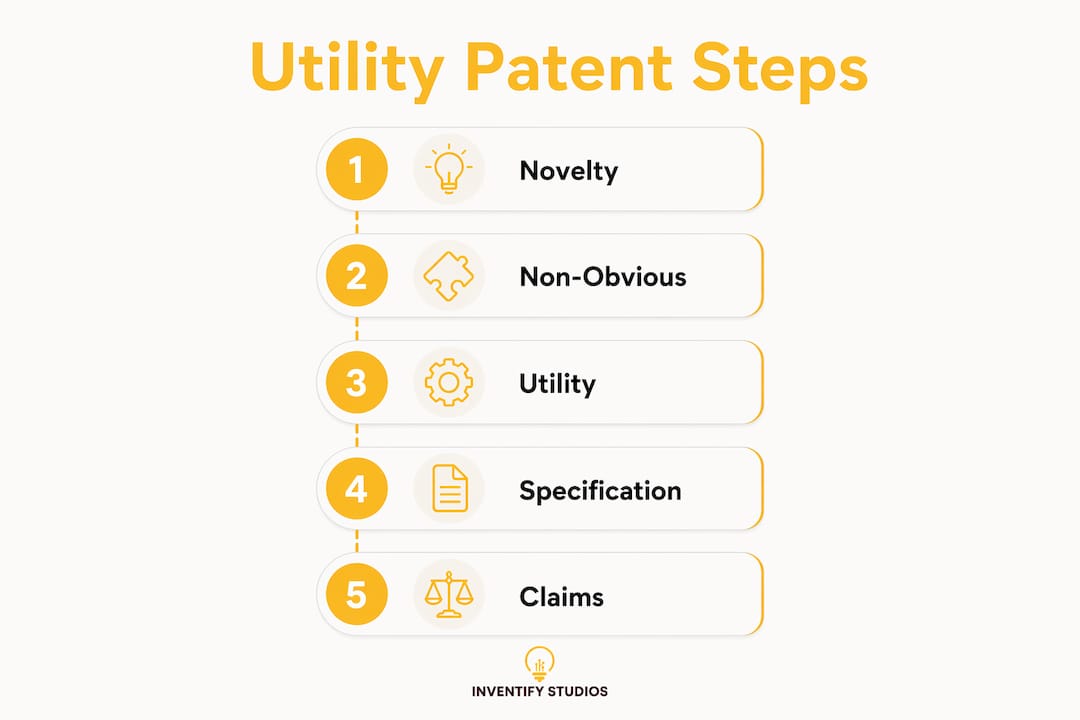
Four requirements must all be met before the USPTO will grant a utility patent. Missing any one of them results in rejection.
- Novelty. The invention must be new. It cannot have been publicly disclosed, sold, or patented anywhere in the world before the filing date. Even the inventor's own public disclosure can destroy novelty if it happened more than 12 months before filing. Patent novelty is the first filter every application faces.
- Non-obviousness. The invention cannot be an obvious variation of existing technology to a person with ordinary skill in the relevant field. This is the hardest requirement to satisfy and the most common ground for rejection.
- Utility. The invention must have a specific, credible, and substantial practical use. Abstract ideas and natural phenomena do not qualify on their own.
- Enablement. The specification must describe the invention in enough detail that a skilled person could reproduce it without undue experimentation. Failing to provide sufficient technical detail at filing typically forces a new application rather than allowing later correction, increasing both cost and risk.
Beyond these four requirements, the claims section defines the actual legal scope of protection. Claims are the most critical strategic part of the application. Independent claims cover broad protection, while dependent claims add specific limitations. Claims drafting is a strategic balance: too narrow invites copying; too broad risks examiner rejection.
Pro Tip: Write your specification before your claims. A detailed, enabling specification gives you the foundation to draft broad, defensible claims. Reversing that order is one of the most common mistakes first-time applicants make.
For a deeper look at what qualifies, the Inventifystudios guide on patentable vs. unpatentable ideas walks through real examples with clarity.
How to file a utility patent: process, timelines, and fees
Filing a utility patent application is a multi-step process. Each step has real consequences if handled poorly.
- Prepare your specification. Write a detailed description of the invention, including how it works, how it is made, and how it differs from prior art. Include drawings wherever they clarify the description.
- Draft your claims. Define the exact scope of protection you are seeking. This is where most applications succeed or fail.
- File through USPTO Patent Center. Submit your nonprovisional utility patent application electronically. Include the specification, drawings, claims, abstract, and filing fee.
- Wait for examination. The average time from filing to grant is approximately 28 months, during which examiners evaluate novelty and non-obviousness. That timeline means planning ahead matters.
- Respond to Office Actions. Office Actions with rejections or objections are a normal part of patent prosecution, requiring negotiation and amendments to claims. Most applications receive at least one.
- Pay issue and maintenance fees. Once granted, maintenance fees must be paid at intervals to keep the patent active for the full 20 years. Missed payments cause the patent to expire early.
Current USPTO filing fees (2026)
| Entity type | Filing fee |
|---|---|
| Micro entity | $400 |
| Small entity | $800 |
| Large entity | $2,000 |
USPTO filing fees are only part of the total cost. Attorney fees can range from $5,000 to $15,000, depending on complexity. That figure reflects the value of professional claims drafting in reducing rejections and strengthening the final patent.
Pro Tip: File a provisional patent application first. It establishes your filing date for 12 months at a lower cost, giving you time to refine your invention and assess market interest before committing to the full nonprovisional application.
The Inventifystudios guide on patent application process steps covers each stage in detail for first-time filers.
What distinguishes a utility patent from other types of patents?
Three types of patents exist under U.S. law: utility, design, and plant. Each protects something different.
| Patent type | What it protects | Term |
|---|---|---|
| Utility patent | How an invention works or is used | 20 years from filing |
| Design patent | Ornamental appearance of an object | 15 years from grant |
| Plant patent | New asexually reproduced plant varieties | 20 years from filing |
Utility patents are generally the most valuable for inventors because functional protection is harder to design around. A competitor can change the shape of a product to avoid a design patent. Avoiding a utility patent requires actually changing how the product works, which is far more difficult and expensive.
Key distinctions worth knowing:
- A design patent protects only the ornamental look of an object, not its function. A uniquely shaped bottle can get a design patent. The formula inside requires a utility patent.
- Plant patents apply to a narrow category of asexually reproduced new plant varieties, such as a new rose cultivar.
- Utility patents cover the widest range of inventions: machines, processes, compositions of matter, and articles of manufacture.
For inventors who need to understand the full picture of intellectual property protection, the Inventifystudios article on patent, trademark, and copyright clarifies what each form of protection actually covers.
What are the benefits and strategic value of securing a utility patent?
A utility patent is a business asset, not just a legal document. Protecting an invention functionally through a utility patent helps attract investors and licenses, and deters competition. That combination of defensive and offensive value is what makes utility patents worth the cost.
The core benefits include:
- Exclusive market position. You can prevent competitors from making, using, or selling your invention for 20 years. That window is long enough to build a dominant market position.
- Licensing revenue. You can license your patent to other companies and collect royalties without manufacturing anything yourself. Many inventors build entire businesses on licensing income alone.
- Investor credibility. A granted patent signals that your invention is novel and non-obvious. Investors and partners treat it as proof of defensible differentiation.
- Legal leverage. A patent gives you standing to sue infringers in federal court. Without one, copying your invention is legal.
- Valuation. Patents appear on balance sheets as intangible assets. They increase company valuation during fundraising or acquisition.
The 20-year protection window is not automatic. Maintenance fees must be paid at 3.5, 7.5, and 11.5 years after grant to keep the patent active. Missing a payment ends protection early, and competitors can immediately begin using your invention. Planning for those fees from day one is part of a sound patent strategy.
Key Takeaways
A utility patent is the strongest form of patent protection available to inventors, covering how an invention works and granting 20 years of exclusive rights in exchange for full public disclosure.
| Point | Details |
|---|---|
| Core protection | Utility patents cover function and use, not appearance, for 20 years from filing. |
| Four requirements | Novelty, non-obviousness, utility, and enablement must all be satisfied for approval. |
| Filing costs | USPTO fees start at $400 for micro entities; total costs including attorneys typically reach $5,000–$15,000. |
| Examination timeline | Average pendency is approximately 28 months; Office Actions are normal and require active responses. |
| Strategic value | Patents attract investors, generate licensing revenue, and provide legal standing against infringers. |
Why most inventors underestimate what a utility patent actually demands
I have seen inventors spend months building a product and then rush the patent application in a week. That order of priorities is backwards. The specification you file on day one is the foundation of everything that follows. You cannot add new technical details later without filing a new application. That means a thin, vague specification locks you into thin, vague protection forever.
The examination process also surprises people. Receiving an Office Action feels like a rejection, but it is actually an invitation to negotiate. Most patents require at least one round of amendments before they are granted. Inventors who treat the first Office Action as a failure often abandon applications that were genuinely close to approval.
Cost is the other reality check. USPTO fees are manageable. Attorney fees are not trivial, but they are an investment in claim quality. A poorly drafted claim that is too narrow gets copied the moment your patent publishes. A well-drafted claim costs more upfront and saves far more over the life of the patent.
My honest advice: align your patent strategy with your business goals before you file. If you plan to license, you need broad claims. If you plan to manufacture, you need claims that specifically cover your product. Those are different documents, and writing them requires knowing where you are going.
— Hua
Inventifystudios can help you move from idea to patent-ready
Preparing a utility patent application takes real technical and legal precision. Inventifystudios gives inventors the tools to get there faster and at a fraction of traditional consulting costs.

With Inventifystudios, you can assess your invention's patentability with AI-powered analysis, generate 3D prototypes in minutes, and receive tailored drafting insights for provisional patents. The platform is built for first-time inventors and experienced entrepreneurs alike. It removes the guesswork from early-stage patent preparation so you can file with confidence. Visit the Inventifystudios invention detail page to see exactly how the platform supports your path from concept to protected IP.
FAQ
What is the utility patent definition in simple terms?
A utility patent is a government-issued right that lets an inventor exclusively make, use, sell, or import a new and useful invention for 20 years from the filing date. It protects how an invention works, not how it looks.
Who can apply for a utility patent?
Any individual inventor, startup, or corporation can apply for a utility patent through the USPTO, regardless of size. Micro and small entities qualify for reduced filing fees, which lowers the barrier for independent inventors.
How long does the utility patent process take?
The average time from filing to grant is approximately 28 months. Complex applications or those requiring multiple Office Action responses can take longer.
What is the difference between a utility patent and a design patent?
A utility patent protects the functional aspects of an invention, while a design patent protects only its ornamental appearance. Functional protection is generally more valuable because it is harder for competitors to design around.
What happens if I miss a maintenance fee payment?
Missing a maintenance fee causes the utility patent to expire before its 20-year term ends. Once expired, the invention enters the public domain and competitors can legally use it without restriction.