

Under 35 U.S.C. § 112(a), your patent specification must describe your invention "in such full, clear, concise, and exact terms" that a person skilled in the relevant art can make and use it without undue experimentation. That is the enablement requirement in one sentence. The immediate practical consequence: claims that reach beyond what your specification actually teaches can be invalidated. Draft your spec so a skilled person can reproduce at least one working version of everything you claim.
- The specification must enable making the invention and using it.
- Enablement is judged as of the filing date, not later.
- Broader claims demand broader disclosure.
Table of Contents
- Why the enablement requirement can make or break your patent
- How the USPTO and courts evaluate enablement
- What your specification must include to meet enablement
- How to respond when you receive an enablement rejection
- How prototypes and provisional applications support enablement
- Enablement vs. written description: they are not the same
- How enablement shapes claim amendments and continuations
- Enablement requirements in Europe and Japan
- Key Takeaways
- The part most inventors get wrong about enablement
- Inventifystudios helps you build an enabling disclosure from day one
- Authoritative sources for further reading
Why the enablement requirement can make or break your patent
An enablement failure does not just trigger an office action. It can narrow your claims during prosecution, invalidate an issued patent in litigation, or strip you of the exclusivity you spent years building. For individual inventors, those stakes are real.
The most common misconception: a handful of working examples automatically enables a broad functional claim. Amgen v. Sanofi demolished that assumption. Amgen disclosed 26 exemplary antibodies yet claimed a vastly larger class. The Supreme Court held the patents invalid for lack of enablement. Enablement failures are most likely in unpredictable technologies, broadly functional or genus claims, and any claim that sweeps far beyond the examples you actually built and tested. Understanding why patent applications get rejected before you file is the fastest way to avoid this trap.
How the USPTO and courts evaluate enablement
The statutory anchor is 35 U.S.C. § 112(a), which requires the specification to describe the manner and process of making and using the invention. The practical test, drawn from In re Wands, asks whether practicing the invention requires undue experimentation.
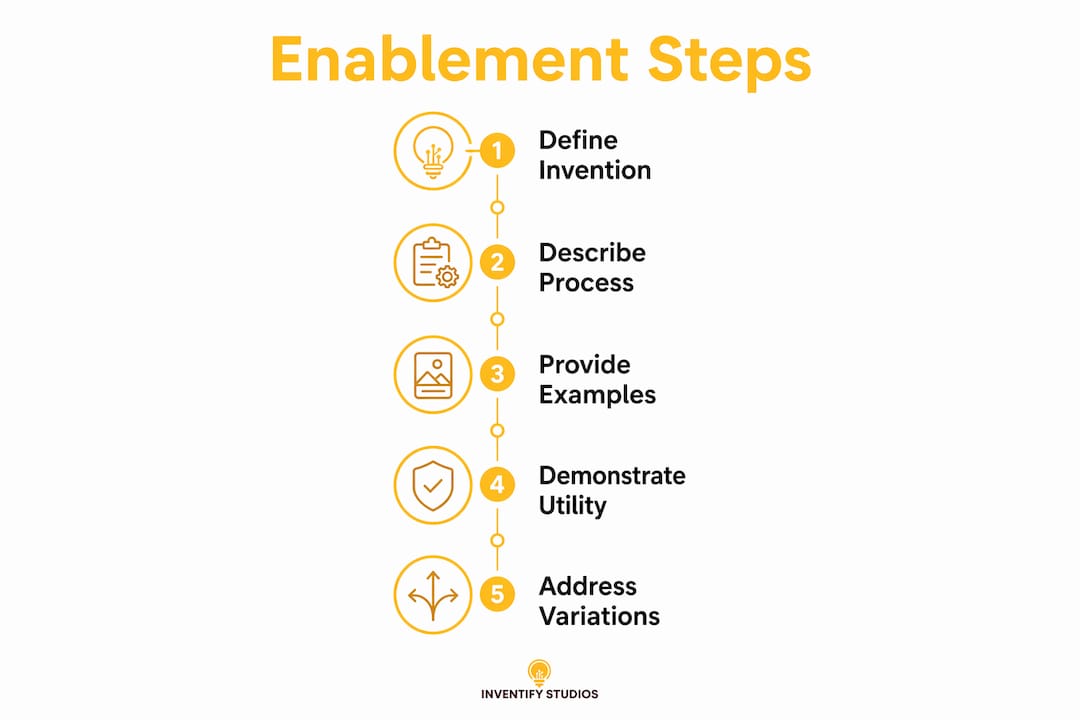
The Wands factors are cumulative — no single factor is dispositive:
| Wands Factor | What examiners look at |
|---|---|
| Breadth of claims | How far the claim extends beyond the examples |
| Nature of the invention | Predictable vs. unpredictable technology |
| State of the prior art | What skilled artisans already know |
| Level of ordinary skill | How much background a practitioner brings |
| Predictability | Whether small changes produce expected results |
| Direction provided | How specific the spec's guidance is |
| Working examples | Number and quality of demonstrated embodiments |
| Quantity of experimentation | How much trial-and-error a skilled person would need |
Post-Amgen, the USPTO's 2024 Federal Register guidance directs examiners to apply Wands factors across all technologies and to provide clear, fact-based explanations for any enablement finding. Predictable arts tolerate broader claims with fewer examples; unpredictable arts require detailed protocols and multiple working embodiments.
Key practical rule from Amgen: disclosing a stable, general quality that runs through an entire claimed class can enable that class — but if no such quality exists, representative structural examples across the class are required.
What your specification must include to meet enablement
Map every claim limitation to a specific disclosure location before you file. That single habit prevents most enablement rejections. Here is what to include:
- At least one fully worked embodiment: materials, components, quantities, and step-by-step method.
- Parameter ranges and tolerances: temperature, pressure, concentration, dimensions — whatever controls the result.
- Multiple embodiments for broad claims: cover representative variations across the claimed class, or disclose the general quality that makes the whole class predictable.
- Best mode (if applicable): the version you believe works best at filing.
- Troubleshooting notes: what fails and why, especially in unpredictable fields.
- Clearly labeled protocols and data: examiners review faster when examples are organized and cross-referenced to claim language.
The role of embodiments in patent writing is often underestimated. A single example may satisfy enablement for a narrow claim; a genus claim needs far more.
Pro Tip: Label each working example with a heading (e.g., "Example 1 — Synthesis of Compound A") and add a cross-reference table showing which claim limitations each example supports. Examiners can confirm coverage at a glance, which shortens prosecution.

How to respond when you receive an enablement rejection
Start by mapping the examiner's objection to specific claim language and specific disclosure locations. The MPEP requires examiners to state on the record why the disclosure is inadequate for the full claim scope — if that explanation is missing or vague, call it out in your response.
Response structure that works: (1) Restate the examiner's specific objection. (2) Point to the exact specification location that enables each challenged limitation. (3) Argue each Wands factor in your favor with facts. (4) Conclude that no undue experimentation is required.
Your practical options when the rejection has merit:
- Narrow the claims to match what the spec actually enables.
- Submit evidence: lab notebooks, prototype photos, test data, or a third-party expert declaration.
- File a continuation with added examples before the parent issues, capturing post-filing work in a new application.
- Argue reasonable experimentation under Wands — some experimentation is allowed; only undue experimentation fails the test.
One caution on declarations: introducing new technical content to cure a disclosure gap can raise new-matter issues. Keep declarations focused on what a skilled artisan would have understood from the original spec, not on new data you generated after filing.
How prototypes and provisional applications support enablement
A working prototype is your best pre-filing asset. It proves the invention works and generates the concrete parameters your specification needs.
- Document everything at build time: dated lab notes, build instructions, photos or video, measurements, and test results tied to specific claim elements.
- Use provisional filings to lock in disclosure: a provisional preserves your filing date, but enablement is assessed as of that filing date — a thin provisional does not protect a priority date if the disclosure is inadequate.
- Do not rely on post-filing work to cure gaps: experiments completed after filing generally cannot broaden or fix the original disclosure.
- Tie prototype data to claim language: if your claim recites a specific temperature range, your prototype documentation should show you tested that range.
The invention prototype patent connection runs deeper than most inventors realize. Thorough prototype documentation is prosecution ammunition, not just a development record.
Enablement vs. written description: they are not the same
35 U.S.C. § 112(a) contains three separate requirements: written description, enablement, and best mode. Inventors routinely conflate the first two, and that confusion costs them during prosecution.
Written description asks whether the specification shows the inventor possessed the claimed invention at the filing date. It is backward-looking: did you have it? Enablement asks whether a skilled person can reproduce the full scope of the claims from the disclosure. It is forward-looking: can someone else build it?
A specification can fail written description while passing enablement, and vice versa. Fixing one does not fix the other. If an examiner issues both rejections, address each independently with separate arguments and separate disclosure citations.
How enablement shapes claim amendments and continuations
Every time you broaden a claim during prosecution, you increase the enablement burden. Amending a claim to cover a wider class of compounds, a broader method step, or a larger parameter range requires that the original specification already enables that broader scope. You cannot add new enabling disclosure to a pending application without triggering a new-matter rejection under 35 U.S.C. § 132.
Continuations solve this problem. File a continuation before the parent issues, add the new examples or protocols as new matter in the continuation, and claim the broader scope there. The continuation gets a later effective filing date for the new material, but you preserve the parent's date for what was already disclosed. This strategy is especially useful when your prototype testing generates new data after the original filing.
Enablement requirements in Europe and Japan
The U.S. enablement standard has close analogs abroad, but the details differ.
European Patent Office (EPO): Article 83 of the European Patent Convention requires the application to disclose the invention "in a manner sufficiently clear and complete for it to be carried out by a person skilled in the art." The EPO's "sufficiency of disclosure" standard is functionally similar to U.S. enablement, but the EPO tends to apply it more strictly to functional claims and is less tolerant of post-filing experimental data to cure disclosure gaps.
Japan Patent Office (JPO): Article 36(4) of the Japanese Patent Act requires the description to be "clear and sufficient" for a skilled person to work the invention. The JPO's "working requirement" parallels U.S. enablement and similarly focuses on whether the full claim scope is supported. Japanese practice also scrutinizes functional claims in unpredictable fields.
The practical takeaway for inventors filing internationally: draft your U.S. specification with the depth the EPO and JPO require, and you will likely satisfy all three offices. A thin U.S. spec optimized only for domestic prosecution can create serious problems in PCT and foreign national phase filings.
Key Takeaways
The enablement requirement under 35 U.S.C. § 112(a) is a filing-date obligation: your specification must teach the full scope of your claims before you file, not after.
| Point | Details |
|---|---|
| Claim breadth drives disclosure depth | Broader claims require broader enabling disclosure; narrow to what your spec actually teaches. |
| Wands factors are your roadmap | Address all eight factors proactively in your spec and in any office action response. |
| Enablement ≠ written description | The two are separate inquiries under § 112(a); fix each independently if both are rejected. |
| Prototypes must be documented at build time | Post-filing data generally cannot cure a pre-filing disclosure gap. |
| Inventifystudios tools | Inventifystudios helps inventors capture prototype data, organize disclosure fragments, and draft provisional patent narratives before filing. |
The part most inventors get wrong about enablement
Most inventors treat the specification as a formality they complete after the real work is done. That instinct is backwards. The specification is the invention, legally speaking. If you cannot describe how to make and use every variation you want to claim, you do not yet own that scope — regardless of what you built in your garage.
The Amgen decision made this concrete in a way that should reset how every inventor thinks about functional claims. Amgen had 26 working antibodies and decades of research behind them. The Supreme Court still said: not enough. That outcome is not a technicality. It reflects a principle that has been in U.S. patent law since 1790 — you get exclusivity over what you teach, not over what you imagine.
For individual inventors, the practical implication is this: document your prototype with the same rigor you would use to write a lab report. Map every claim limitation to a specific disclosure location before you file. And if you are tempted to claim a broad functional genus, either disclose the general quality that makes the whole class predictable or narrow the claim to what you can actually enable. A narrower patent you can enforce beats a broad one that gets invalidated.
Inventifystudios helps you build an enabling disclosure from day one
Getting your specification right before filing is faster and less expensive than fixing it during prosecution. Inventifystudios gives individual inventors the tools to do exactly that: an AI-powered prototype generator that produces documented 3D concepts with parameter data, a patentability analysis that flags claim-scope risks early, and provisional patent drafting guidance that structures your disclosure around claim limitations.
Every feature maps directly to an enablement task. The prototype generator captures the working embodiment your spec needs. The documentation tools organize lab notes, parameter tables, and build records into exportable disclosure fragments. The provisional drafting assistant helps you structure examples so each claim limitation has a clear disclosure location — the exact habit that prevents most enablement rejections.
Ready to build a specification that holds up? Start your invention on Inventifystudios and get your prototype, patentability analysis, and provisional draft in one place.
Authoritative sources for further reading
Save these primary sources in your prosecution binder and cite them when responding to office actions:
- 35 U.S.C. § 112(a) — the statutory text; the legal foundation for every enablement argument.
- MPEP § 2164 — The Enablement Requirement — USPTO examiner guidance on how enablement is evaluated, including Wands factors and undue experimentation.
- MPEP § 2161 — Three Separate Requirements Under § 112(a) — distinguishes enablement, written description, and best mode; use when addressing compound rejections.
- USPTO Federal Register Guidance, January 2024 — post-Amgen examiner instructions; cite this when arguing that an examiner's Wands analysis is incomplete.
- Amgen Inc. v. Sanofi, 598 U.S. 594 (2023) — the controlling Supreme Court case on claim breadth and enablement; essential reading before drafting any functional genus claim.
This article is general legal information, not legal advice. Confirm current USPTO rules and your specific situation with a registered patent practitioner before filing.