

Patent cost is what you pay today. Patent value is the future economic benefit that patent can create — and those two numbers are rarely the same. Understanding the gap between them is the core of every smart IP decision you will make.
The quick verdict: for any patent with a commercial application, estimate value using an income- or market-based method first. Treat cost as a floor, not a ceiling. Then compare your present-value estimate to the remaining scheduled fees at the next maintenance milestone (3.5, 7.5, or 11.5 years from grant) before deciding whether to keep, monetize, or let it lapse.
What "cost" covers:
- Filing fees (provisional and non-provisional)
- Attorney drafting and prosecution fees
- USPTO issue fees
- Maintenance fees at 3.5, 7.5, and 11.5 years
- Foreign filing and translation costs (if applicable)
What "value" means:
- Licensing royalty streams
- Product margin protection
- M&A or fundraising leverage
- Defensive blocking against competitors
Quick context on ranges: according to PatentBrief, a small-entity inventor typically spends $10,000–$25,000 to obtain a utility patent, plus $7,000–$15,000 in maintenance and prosecution over the patent's 20-year life. A patent worth protecting commercially can generate multiples of that in licensing revenue or competitive advantage — or nothing at all if the market never materializes.
Key Takeaways
The single most important principle: patent cost is a floor, not a measure of value — always estimate forward-looking commercial benefit using income or market methods before making a keep, abandon, or monetize decision.
| Point | Details |
|---|---|
| Cost vs. value distinction | Cost covers fees and attorney time; value is the present value of future economic benefits the patent enables. |
| All-in cost ranges | Small-entity utility patents typically run $10,000–$25,000 to obtain, plus $7,000–$15,000 in maintenance over 20 years. |
| Preferred valuation method | Use the income approach (DCF or relief-from-royalty) for commercial patents; treat cost approach as a floor only. |
| Decision rule | Keep if present value of benefits exceeds 2× remaining costs; otherwise pursue licensing, sale, or abandonment. |
| Inventifystudios | Provides AI-powered patentability analysis and provisional drafting guidance to validate demand before full prosecution costs. |
Table of Contents
- What does a patent actually cost you?
- What does "patent value" actually mean for your business?
- Which valuation method should you use?
- How to compare remaining costs to projected value
- What are your options when costs exceed expected value?
- When does a professional patent valuation make sense?
- Common mistakes that distort patent cost-benefit decisions
- The hidden costs of maintaining a patent you are not using
- How portfolio size and quality shape overall patent value
- Risks that can reduce a patent's value without warning
- The real trade-off most small inventors get wrong
- Inventifystudios cuts the cost of testing patent value before you commit
- Primary sources and further reading
- Sources
What does a patent actually cost you?
Cost is the easier side of the equation to pin down. It breaks into four buckets: government fees, attorney fees, prosecution costs, and maintenance fees. The USPTO fee schedule sets the official government-side numbers, organized by entity size: large entity, small entity (50% reduction), and micro-entity (80% reduction).
Attorney and prosecution fees are where the real money goes. PatentBrief notes that attorney and prosecution costs typically far exceed USPTO fees, supporting a common all-in cost range for small-entity utility patents. MadePatents puts most utility patents in a moderate cost band, with complex cases costing more.
Foreign filing adds another layer entirely. A PCT application plus national-phase entries in Europe, Japan, and Canada can push total lifecycle costs significantly higher for a single invention.
Pro Tip: Check your micro-entity eligibility before every USPTO filing. You also must file electronically through Patent Center — paper filings trigger a separate non-electronic filing surcharge that wipes out part of your discount.
What does "patent value" actually mean for your business?
Value is a forward-looking number, not an accounting entry. The money you spent getting a patent is a sunk cost. What matters for business decisions is the incremental economic benefit the patent can generate from this point forward.
Two frameworks exist: accounting value and commercial value. Accounting value treats the patent as a capitalized asset on your balance sheet, typically equal to the cost to create or acquire it. Commercial value asks a different question entirely: what future cash flows does this patent enable, protect, or unlock?
The business outcomes that convert a patent into real economic value include:
- Licensing revenue: royalties paid by third parties to use your protected technology
- Product margin protection: the ability to charge premium prices because competitors cannot copy your solution
- Fundraising leverage: patents signal defensibility to investors and can improve term-sheet terms
- M&A uplift: acquirers pay more for companies with defensible IP portfolios
- Enforcement settlements: the credible threat of litigation can produce licensing agreements without going to trial
Which perspective you use depends on your goal. If you are negotiating a license, you need an income-based estimate of what the licensee will earn. If you are preparing a balance sheet for a funding round, cost-based figures may satisfy your accountant but will not impress a lead investor. For protecting your invention's value in a competitive market, commercial value is the number that drives decisions.
Which valuation method should you use?
Three standard approaches exist for patent valuation. Each answers a slightly different question, and each has real limitations. CASRAI's patent valuation guide notes that the income approach is generally preferred for patents with forecastable revenue streams.
Income approach
The income approach estimates the present value of future cash flows attributable to the patent, typically using discounted cash flow (DCF) analysis or a relief-from-royalty model. You project revenues the patent enables, apply a royalty rate or margin premium, then discount at a risk-adjusted rate.
Best for: commercial patents with identifiable revenue streams, licensing negotiations, investor presentations. Weakness: highly sensitive to discount rate assumptions and the difficulty of isolating patent-attributable cash flows from other business factors.
Market approach
The market approach compares your patent to similar transactions: licenses, sales, or court-awarded damages for comparable technologies. When good comparables exist, this method produces the most defensible market-value estimate.
Best for: technologies with active licensing markets, M&A due diligence. Weakness: comparable transaction data is often confidential or simply unavailable for niche technologies.
Cost approach
The cost approach calculates what it would cost to recreate or replace the patented invention. WIPO's IP valuation guidance cautions that the cost approach usually establishes a floor rather than a true market value. EPO guidance confirms that many companies default to cost-based metrics for internal reporting, even though income approaches better answer market-value questions.
Best for: early-stage patents with no revenue history, balance-sheet entries, sanity-check floors. Weakness: a patent that cost $20,000 to obtain may be commercially worthless — or worth $2 million. Cost tells you neither.
| Method | Best Use Case | Main Weakness |
|---|---|---|
| Income (DCF / relief-from-royalty) | Licensing, investor decks, commercial decisions | Sensitive to discount rate; requires revenue forecast |
| Market (comparables) | M&A, active licensing markets | Comparable data often unavailable |
| Cost (replacement / reproduction) | Floor value, bookkeeping, early-stage | Ignores commercial potential entirely |
Pro Tip: Run all three methods and triangulate. If your income estimate is 10× your cost floor, that gap is a signal — either the patent is genuinely valuable or your revenue assumptions are too optimistic. Sensitivity-test your discount rate by ±3 percentage points to see how much the income estimate moves.
How to compare remaining costs to projected value
This five-step process gives you a keep/abandon/monetize decision in under an hour for most patents.
-
Define your scenario. What is the patent's remaining life? What product or license revenue does it protect or enable? Set a realistic horizon (typically 5–10 years for commercial patents).
-
Run a quick relief-from-royalty estimate. Example: your product generates $500,000 per year in revenue. A reasonable royalty rate for your technology category is 5%. That implies $25,000 per year in patent-attributable value. Discounted at 15% over 7 remaining years, the present value is approximately $104,000.
-
List your remaining costs. Add up the next maintenance fee due, any expected prosecution or office-action costs, and a reserve for potential enforcement. Example: $2,000 maintenance at 7.5 years + $3,000 prosecution reserve = $5,000 near-term cost.
-
Compare. In this example, $104,000 present value versus $5,000 near-term cost is a clear "keep" decision. If the present value were $4,000 and the costs $5,000, the math points toward abandonment or a quick licensing push.
-
Apply a safety factor. Because forecasts are uncertain, many practitioners use a 2× safety factor: keep the patent only if the present value of expected benefits exceeds 2× remaining costs. This accounts for optimism bias in revenue projections.
Decision checklist:
- Present value of benefits > 2× remaining costs → keep and maintain
- Present value of benefits between 1× and 2× remaining costs → pursue licensing or sale before next maintenance deadline
- Present value of benefits < 1× remaining costs → consider abandonment or defensive lapse
If the decision flips from "keep" to "abandon" within that range, the call is genuinely close and a professional valuation is worth considering.*
What are your options when costs exceed expected value?
When the math does not support maintaining a patent, four paths are available. Each has different legal and commercial consequences.
-
Pay maintenance and continue. Appropriate when the patent has defensive value (blocking competitors) even without active licensing. The cost is known; the benefit is harder to quantify but real.
-
License or sell. A patent generating no direct revenue for you may be worth real money to a competitor or adjacent-market player. Even a modest licensing deal can recover years of maintenance costs. Invention ownership rights and assignment mechanics matter here — confirm ownership is clean before approaching potential licensees.
-
Assign to a third party. An outright assignment transfers all rights in exchange for a lump sum or royalty stream. This removes future maintenance obligations from your budget entirely.
-
Let the patent lapse. Missing a maintenance fee causes the patent to expire. The technology enters the public domain. This is sometimes the right call — particularly for patents covering abandoned product lines or superseded technology.
Strategies to reduce cost without eliminating value:
- Narrow or cancel weaker dependent claims to reduce prosecution exposure
- Let foreign family members lapse in markets where you have no commercial presence
- Use provisional filings to buy 12 months of "patent pending" status while you validate demand before committing to full prosecution costs
- Focus enforcement budget on your highest-value claims rather than defending every patent in a large portfolio
WIPO's guidance on managing patent costs for small and medium enterprises covers portfolio-pruning tactics in detail, including how to prioritize international filings by market priority.
Pro Tip: Before letting any patent lapse, run a quick prior-art check on the claims. A patent you consider low-value may be blocking a competitor's product line — making it worth more to them than to you. A brief licensing inquiry costs almost nothing.
When does a professional patent valuation make sense?
A professional valuation is a formal, defensible analysis prepared by a qualified IP valuation specialist. According to industry practitioners, a single-patent assessment typically costs $5,000–$50,000+, depending on scope, purpose, and portfolio complexity.
That range is wide because purpose drives scope. A valuation for a licensing negotiation needs different depth than one prepared for litigation support or a Series A fundraising round.
Triggers that justify commissioning a valuation:
- Imminent funding round where investors will scrutinize IP assets
- M&A transaction where the patent portfolio is a material deal component
- Licensing negotiation where you need a defensible opening position
- Dispute resolution or litigation where damages calculations require formal support
- Internal portfolio review to decide which patents to maintain, sell, or abandon
What to prepare before ordering a valuation (to reduce cost and improve output quality):
- Sales forecasts or revenue models tied to the patented technology
- Comparable licensing deals or transaction data you have access to
- Technical documentation: claims, prosecution history, prior art landscape
- A clear statement of purpose (licensing vs. M&A vs. litigation support changes the methodology)
- Any existing market research or competitive analysis
A well-prepared brief cuts the valuation specialist's research time and produces a more defensible output. Arriving without forecasts or comparables forces the specialist to build assumptions from scratch — which adds both cost and uncertainty.
Common mistakes that distort patent cost-benefit decisions
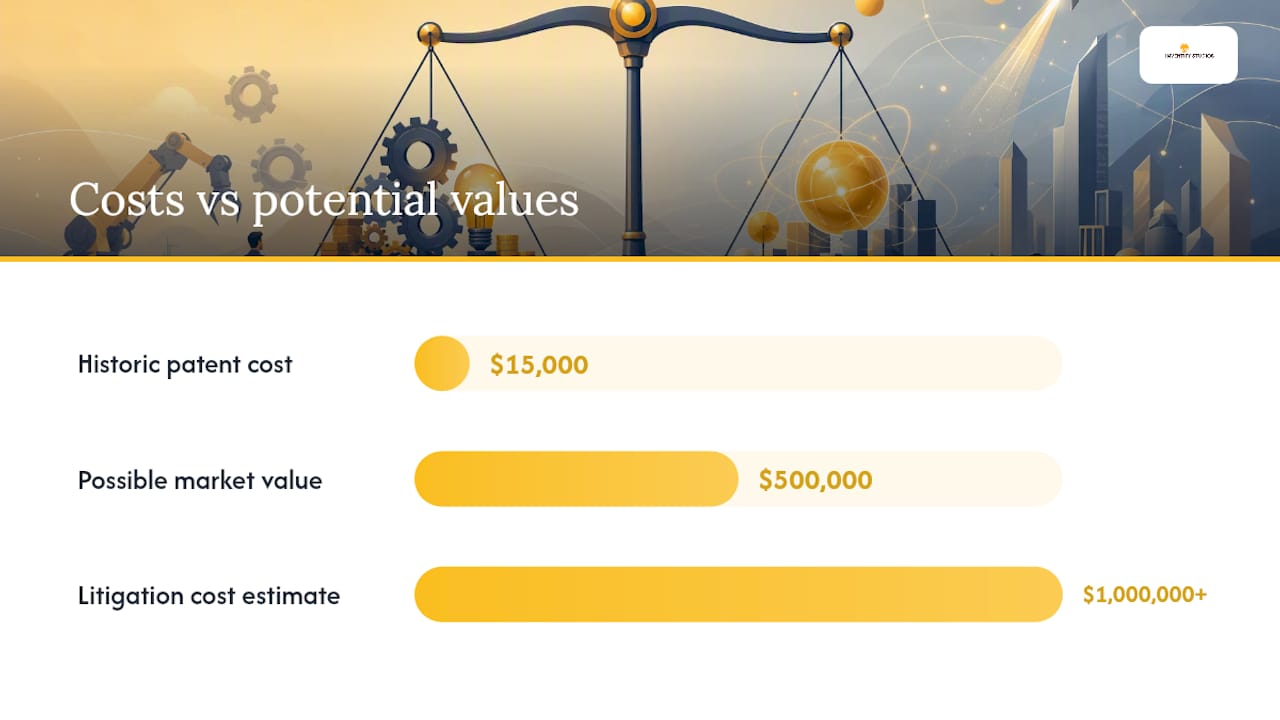
The most expensive mistake inventors make is treating historical cost as market value. A patent that cost $15,000 to obtain is not worth $15,000 on the market. It may be worth $0 or $500,000, depending entirely on what the claims cover and whether anyone needs to use them.
Other frequent errors:
- Ignoring enforcement feasibility. A patent is only as valuable as your ability to enforce it. A broad claim against a well-funded competitor may require $1,000,000+ in litigation costs to defend — which changes the cost-benefit calculation entirely.
- Relying on a single optimistic forecast. Revenue projections for early-stage inventions are notoriously unreliable. A single-scenario DCF without sensitivity analysis is not a valuation; it is a wish.
- Skipping small/micro-entity eligibility checks. Many inventors pay large-entity fees they do not owe. The USPTO fee schedule sets micro-entity fees at 80% below large-entity rates — a difference that compounds significantly across a portfolio.
Trust signals to look for in a valuation report or advisor:
- Independent third-party authorship with no financial stake in the outcome
- Transparent assumptions: discount rates, royalty rates, and market-size figures all stated explicitly
- Comparable transaction data cited by source, not asserted without evidence
- A clear statement of purpose and scope at the front of the report
- Reference to recognized frameworks (AIPLA guidelines, WIPO or EPO valuation methodologies)
A quick sanity check: take the valuation's implied royalty rate and compare it to published industry benchmarks for your technology category. If the implied rate is 3× the sector average, the assumptions need scrutiny.
The hidden costs of maintaining a patent you are not using
The direct fees are only part of the picture. Maintaining a patent you are not actively commercializing or licensing carries real indirect costs that rarely appear in a simple fee schedule.

Management time is one. Tracking maintenance deadlines, responding to office actions, and monitoring the competitive landscape for infringement all consume hours that could go toward product development or sales. For a solo inventor or early-stage startup, that opportunity cost is tangible.
Capital allocation is another. Every dollar spent on a maintenance fee for a low-value patent is a dollar not spent on prototyping a new idea, running a market test, or funding a provisional application on a higher-potential invention. The cost-benefit of patents shifts significantly when you account for what else that capital could do.
There is also the risk of false security. A patent that looks valuable on paper but covers a market that has moved on provides no real protection. Inventors who maintain patents out of inertia rather than strategy often discover too late that the claims no longer cover the product they are actually selling.
The flip side is equally real. Letting a patent lapse prematurely — before a licensing opportunity materializes or before a competitor enters the market — can destroy value that was genuinely there. The decision is not "patents cost money, therefore abandon them." It is "does the expected future benefit, probability-weighted and discounted, exceed the remaining cost?"
How portfolio size and quality shape overall patent value
A single patent is fragile. One successful invalidity challenge, one claim construction ruling, or one design-around by a well-funded competitor can eliminate its commercial value overnight. A portfolio of related patents covering multiple aspects of the same technology is far more durable.
Portfolio value does not scale linearly with size. Ten weak patents covering marginal variations of the same claim are worth less than three strong patents with broad, well-drafted independent claims. Claim scope and quality drive enforceability, and enforceability drives commercial value.
For entrepreneurs building a patent portfolio, the practical implication is to invest in quality over quantity. A well-drafted independent claim with strong prosecution history is worth more than five narrowly drafted dependent claims that a competitor can design around in six months. Portfolio strategy should also account for geographic coverage: a U.S. patent with no foreign counterparts offers no protection in markets where your product competes.
Risks that can reduce a patent's value without warning
Patent value is not static. Several external forces can erode it between the day you file and the day you try to monetize.
Market shifts are the most common. A patent covering a technology that the market has moved past — because a superior approach emerged or consumer preferences changed — may be technically valid but commercially worthless. This is why income-approach valuations require regular updates, not a one-time calculation.
Legal environment changes are harder to predict. Inter partes review (IPR) proceedings at the USPTO's Patent Trial and Appeal Board have invalidated a significant share of challenged patents since their introduction. A patent that looked bulletproof at grant may face a credible invalidity challenge if a well-funded competitor decides to fight. For software and business-method patents, eligibility challenges under 35 U.S.C. § 101 remain an ongoing risk.
Competitive design-arounds reduce value without invalidating the patent. If a competitor can achieve the same functional outcome through a different technical path, your patent's market exclusivity shrinks even if the patent itself remains valid.
Regulatory changes can open or close markets unexpectedly. A patent covering a medical device or pharmaceutical compound is worth more in a favorable regulatory environment and less if the relevant approval pathway tightens.
Protecting your app idea or software invention carries additional risk layers, since software patent eligibility doctrine continues to evolve in ways that affect portfolio value for technology-focused inventors.
The real trade-off most small inventors get wrong
The conventional wisdom says: file early, file broadly, and maintain everything. That advice serves patent attorneys well. It does not always serve inventors.
The honest reality is that most patents never generate licensing revenue. The ones that do tend to share a few characteristics: they cover a technology with a large addressable market, the claims are broad enough to be difficult to design around, and the owner has the resources and willingness to enforce them. A patent that checks none of those boxes is a cost center, not an asset.
For small inventors and early-stage startups, the practical rule is this: before committing to full prosecution, validate that the market actually wants the product. A provisional application buys 12 months of "patent pending" status at a fraction of the cost of a non-provisional. Use that time to test demand, find potential licensees, or raise the capital that makes full prosecution worthwhile.
If the projected net present value of the patent's benefits is less than 2× the remaining costs, the math is telling you something. That does not mean abandon the patent automatically — defensive value, investor signaling, and portfolio fit all matter. But it does mean the decision deserves a hard look rather than an automatic renewal.
The inventors who make the best IP decisions treat patents as business tools, not trophies. Cost is a constraint. Value is the goal.
Inventifystudios cuts the cost of testing patent value before you commit
The biggest risk in patent investment is spending $15,000–$40,000 on prosecution before you know whether the market wants the product. Inventifystudios addresses that directly. The platform gives inventors AI-powered patentability analysis, 3D prototype generation, and provisional patent drafting guidance — all before you engage a full-service attorney for prosecution.

That means you can validate commercial demand, run a prior art check, and build the market-signal data that makes an income-approach valuation defensible — at a fraction of traditional consulting costs. The market analysis tools help you build the revenue forecasts that a professional valuation or investor presentation requires. Better inputs produce better valuations, and better valuations produce better IP decisions.
If you are at the stage where you need to decide whether a patent is worth pursuing, start with Inventifystudios' invention platform to build the data before you spend on prosecution.
Primary sources and further reading
- USPTO fee schedule: The official source for all filing, search, examination, issue, and maintenance fees, including small-entity and micro-entity discount rules and the non-electronic filing surcharge.
- CASRAI patent valuation methods guide: Explains the income, market, and cost approaches in depth and notes when each is appropriate for different patent types.
- WIPO managing patent costs: Practical guidance for small and medium enterprises on controlling international filing and prosecution costs through portfolio prioritization.
- EPO patent valuation FAQ: Outlines the three standard methods and notes that many companies default to cost-based metrics despite the limitations.
- PatentBrief cost overview: Current all-in cost ranges and a clear explanation of why attorney and prosecution fees dominate total patent spend.
- MadePatents cost guide: Practitioner-survey cost ranges and timelines, useful for budgeting a utility patent from filing through grant.
This article is general information, not a substitute for advice from a qualified financial advisor. Consult a qualified financial professional about your own circumstances before acting on anything here.