
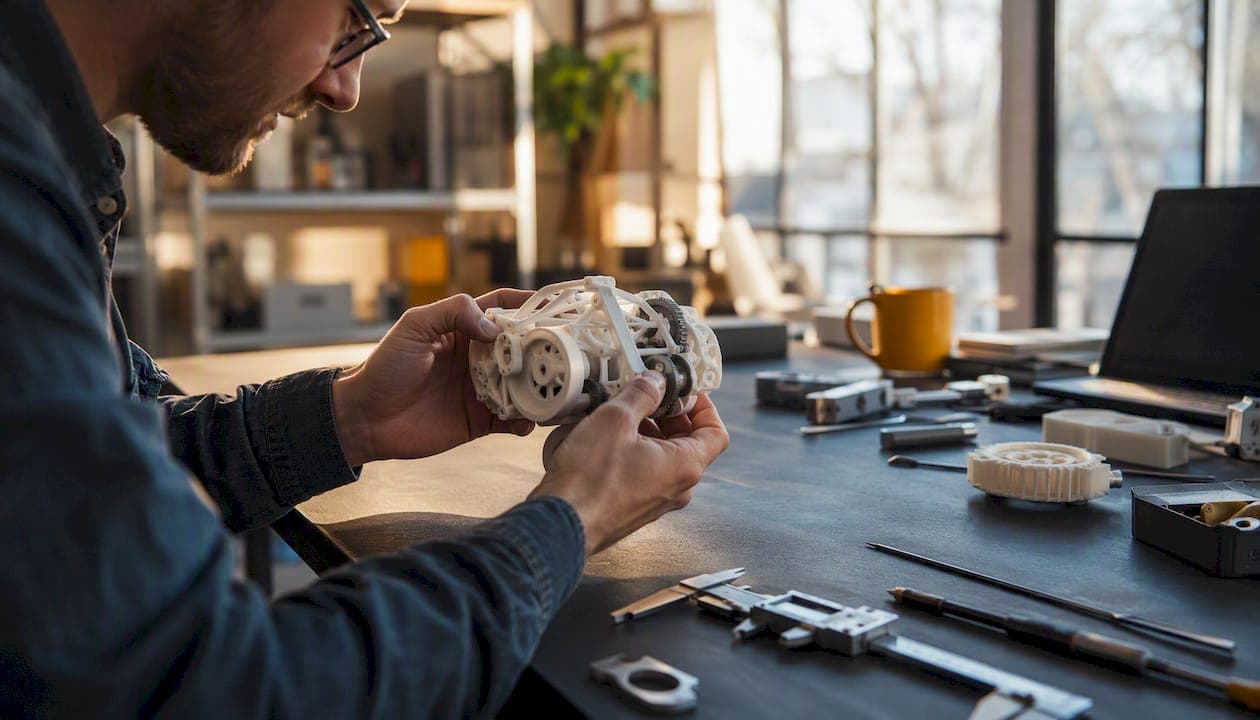
Under U.S. law, patent infringement occurs when someone makes, uses, offers to sell, sells, or imports a patented invention without the patent holder's permission while the patent is valid and enforceable. The controlling statute is 35 U.S.C. §271, and the core rule is straightforward: if an accused product or process practices every element of at least one patent claim, infringement has occurred. Direct infringement is strict liability, meaning a party can infringe without ever knowing the patent exists.
The five acts that typically constitute infringement under §271(a):
- Make: Manufacturing or assembling the patented invention
- Use: Operating or deploying the patented product or process
- Offer to sell: Soliciting a sale, even before delivery
- Sell: Completing a commercial transaction for the patented item
- Import: Bringing the patented invention into the United States
Key Takeaways
Patent infringement under 35 U.S.C. §271 is a strict-liability civil matter requiring every element of at least one patent claim to be present in the accused product or process, and the earliest risk checks consistently produce the best outcomes for inventors.
| Point | Details |
|---|---|
| Statutory definition | §271(a) covers making, using, offering to sell, selling, or importing a patented invention without authorization. |
| How infringement is proved | Courts construe claims first, then compare each element to the accused product; the doctrine of equivalents fills narrow gaps. |
| Top defenses | Invalidity (prior art, obviousness), noninfringement (missing element), license, and patent exhaustion are the strongest arguments. |
| Core remedies | Injunctions, lost profits or reasonable royalty, enhanced damages for willfulness, and attorney fees in exceptional cases. |
| Inventifystudios | The platform's automated prior-art search and documentation tools support early clearance checks before development costs escalate. |
Table of Contents
- What is patent infringement under U.S. law?
- Types of patent infringement you need to recognize
- How courts decide whether infringement occurred
- Common defenses against a patent infringement claim
- What patent owners can recover and what infringers risk
- What a patent infringement lawsuit actually looks like
- What to do if you are accused or if you suspect infringement
- A practical risk-reduction checklist for inventors
- Why infringement risk is a design problem, not just a legal one
- Inventifystudios gives inventors a faster path to clearance
- Sources
What is patent infringement under U.S. law?
35 U.S.C. §271 is the statute that defines infringement and its variants. Section 271(a) covers direct infringement by anyone who, without authority, performs any of the five acts listed above during the patent term. Subsections (b) and (c) address indirect infringement: (b) covers active inducement of another to infringe, and (c) covers contributory infringement by supplying a specially adapted component.
Other subsections extend liability to specific contexts. Section 271(e) carves out a research safe harbor for activities reasonably related to seeking FDA approval for drugs or biologics, which is why generic drug manufacturers can conduct clinical testing before a patent expires without triggering liability. Section 271(f) reaches components exported from the United States for assembly abroad when that assembly would infringe if done domestically. Section 271(g) covers importing products made by a patented process.
Key statutory mappings:
- Make → manufacture: Building a device that reads on every claim element
- Use → operate: Running a patented software process on a server
- Offer to sell → solicit: Listing a patented product in a catalog or on a website
- Sell → transact: Completing a purchase order for the patented item
- Import → bring in: Shipping a finished product into a U.S. port
One critical distinction: the patent claims, not the specification's description or drawings, define the scope of protection. Courts read claims in light of the specification and prosecution history, but the claims themselves are the legal boundary. A product that copies every feature described in the specification but misses one claim element does not infringe that claim.
Types of patent infringement you need to recognize
Direct (literal) infringement
Direct infringement is the simplest form. A product or process infringes literally when it meets each and every limitation of at least one patent claim. If a claim requires elements A, B, and C, a product with A, B, and C infringes. A product with only A and B does not, regardless of how similar it looks to the patented invention.
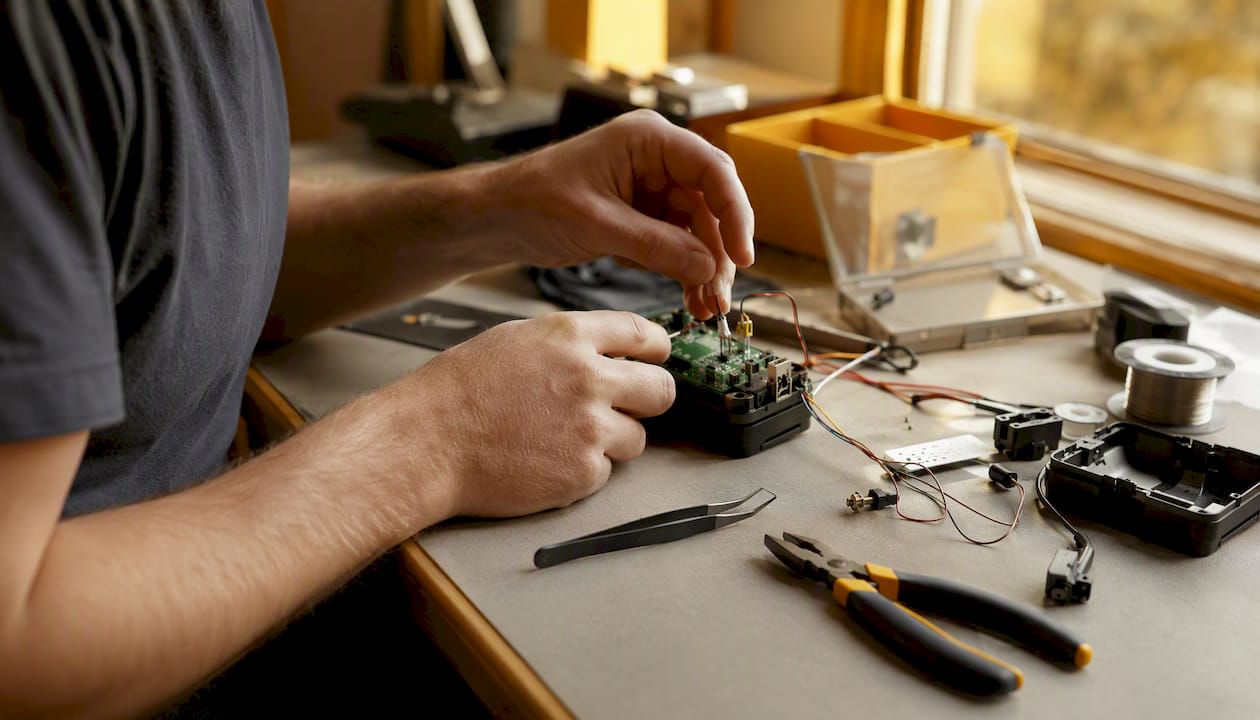
Example: A patent claims a water filter with a carbon block, a UV lamp, and a flow-rate sensor. A competitor's filter that includes all three elements infringes that claim literally, even if the competitor used different materials for the housing.
Indirect infringement: inducement and contributory
Inducement under §271(b) requires proof that the defendant actively encouraged a third party to infringe and knew the acts being encouraged constituted infringement. Selling a product with instructions that walk users through an infringing process is a classic inducement scenario.
Contributory infringement under §271(c) targets suppliers. Contributory infringement requires supplying a component especially made for use in an infringing product, with knowledge that the component is designed for infringement and that it is not a staple article suitable for substantial noninfringing use. A generic screw is a staple article; a custom-machined part that fits only one patented assembly is not.
Divided and joint infringement
When no single party performs every step of a method claim, courts ask whether one party directs or controls the others. Under Akamai Technologies v. Limelight Networks, divided infringement can create liability when one party conditions another's participation or integrates their steps into a joint enterprise. This matters most for multi-step software and network patents.
Willful infringement
Willful infringement means the defendant acted with deliberate or reckless disregard of a known patent. After Halo Electronics v. Pulse Electronics (2016), courts apply a subjective standard: did the infringer know of the patent and proceed anyway without a reasonable basis to believe the patent was invalid or not infringed? A finding of willfulness opens the door to enhanced damages of up to three times the compensatory award.
Pro Tip: During product development, if a competitor's patent surfaces in a prior-art search, document your design-around rationale in writing immediately. That contemporaneous record is your first line of defense against a willfulness finding later.
How courts decide whether infringement occurred
Courts use a two-step process to reach an infringement finding, and understanding both steps tells you where the real leverage points are.
Step 1: Claim construction
Before comparing anything, a court must determine what the patent claims actually mean. This happens in a Markman hearing, where the judge construes disputed claim terms using the patent's specification, prosecution history, and sometimes expert testimony. The prosecution history matters because statements made to the USPTO during examination can narrow a claim's scope through prosecution history estoppel, blocking later attempts to recapture surrendered ground.
Step 2: Comparison to the accused product
Once claims are construed, the court compares each claim element to the corresponding feature of the accused product or process. Courts use claim construction then comparison to determine infringement, and the doctrine of equivalents can apply when accused differences are insubstantial.
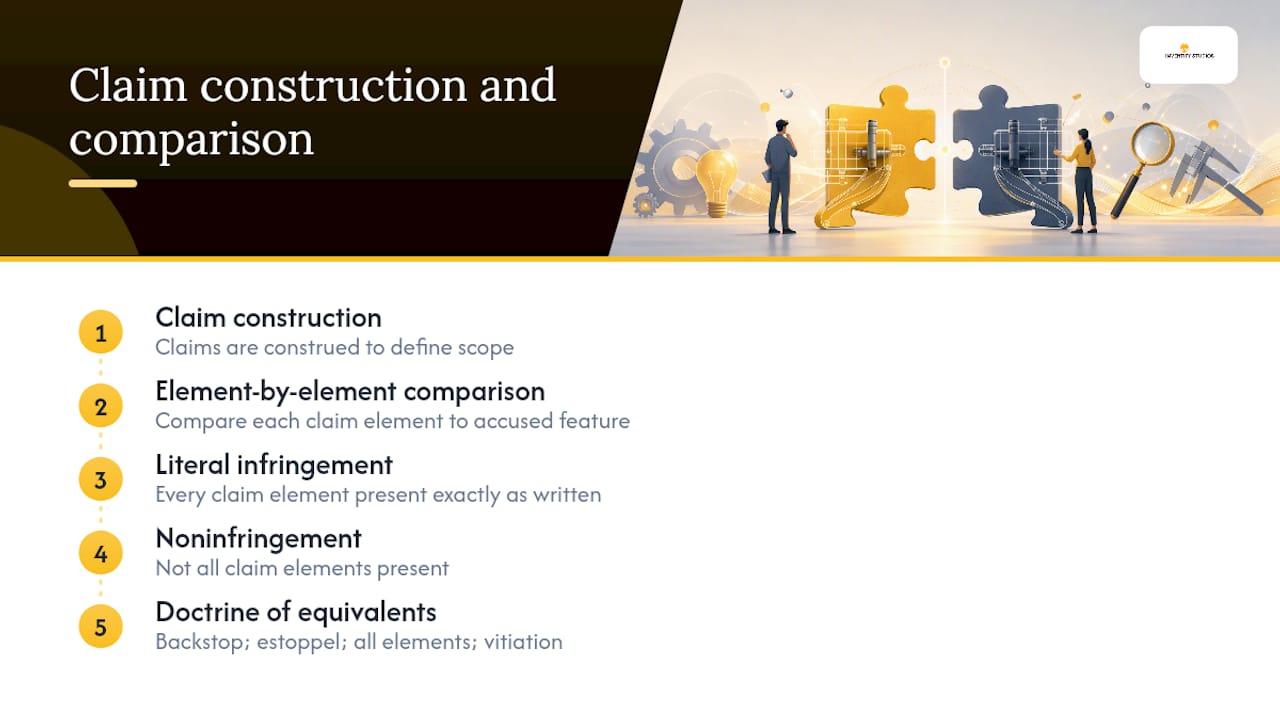
Literal infringement requires every claim element to be present in the accused product exactly as written.
Doctrine of equivalents is a backstop. It finds infringement when an accused element performs substantially the same function, in substantially the same way, to achieve substantially the same result as the claimed element. Three limits constrain it: prosecution history estoppel (you cannot recapture what you surrendered during prosecution), the all-elements rule (equivalents cannot eliminate a claim limitation entirely), and vitiation (you cannot use equivalents to read out a specific claim requirement).
Evidence used in infringement cases
The numbered steps a plaintiff typically follows:
- Identify the asserted claims and obtain a claim construction position
- Map each claim element to a specific feature of the accused product
- Gather technical evidence: product manuals, source code, manufacturing records, CAD files, and sales data
- Retain a technical expert to prepare a claim chart and written report
- Depose the defendant's engineers and product managers
- Present the claim chart and expert testimony at trial or summary judgment
Defendants challenge each step: disputing claim construction, arguing missing elements, attacking expert methodology, or raising invalidity.
Concrete example: A patent claims "a wireless sensor that transmits temperature data at intervals of less than 60 seconds." The plaintiff's expert maps "wireless sensor" to the defendant's Bluetooth module, "transmits temperature data" to its telemetry packet, and "intervals of less than 60 seconds" to its 30-second polling cycle. Each element gets a corresponding product feature, backed by the defendant's own technical documentation.
Common defenses against a patent infringement claim
Accused parties have several credible defenses, and the strongest ones attack the patent itself rather than just the infringement theory.
Invalidity is the most powerful defense. A patent is presumed valid in court, but that presumption can be overcome by clear and convincing evidence. Common invalidity grounds include:
- Prior art: The invention was already known or used before the patent's priority date
- Obviousness: The invention would have been obvious to a person of ordinary skill in the field
- Lack of enablement: The specification does not teach a skilled person how to make and use the invention
- Indefiniteness: The claims are too vague to define the scope of protection
Noninfringement arguments focus on claim construction. If a claim term is construed narrowly enough, the accused product may be missing an element. Design-arounds, where a party modifies a product to avoid a claim limitation, are a legitimate and common strategy.
License and patent exhaustion are complete defenses. A licensed party cannot infringe within the scope of its license. Under the exhaustion doctrine, once a patent owner sells a patented item, patent rights in that specific item are exhausted and cannot be reasserted against downstream purchasers.
Experimental use is a narrow common-law defense covering purely philosophical or academic experimentation with no commercial purpose. It rarely succeeds in practice because most research has some commercial dimension.
Inequitable conduct and patent misuse are equitable defenses. Inequitable conduct requires proof that the patent applicant intentionally withheld material information from the USPTO. Patent misuse covers attempts to extend patent rights beyond their lawful scope, such as tying arrangements.
The USPTO examines and issues patents but does not adjudicate infringement. That role belongs exclusively to federal district courts, with appeals to the Court of Appeals for the Federal Circuit. Accused parties can also challenge patent validity through inter partes review (IPR) at the Patent Trial and Appeal Board (PTAB), which uses a lower "preponderance of the evidence" standard than federal court and can be a faster, cheaper path to invalidating a weak patent.
What patent owners can recover and what infringers risk
Patent infringement is a civil matter. There are no criminal penalties for ordinary infringement. Remedies come in two categories: injunctive relief and monetary damages.
Injunctions were once nearly automatic after a finding of infringement, but eBay Inc. v. MercExchange (2006) changed that. The Supreme Court held that a patent owner must satisfy the traditional four-factor equitable test to obtain a permanent injunction, meaning a practicing entity that competes directly with the infringer is more likely to get one than a non-practicing entity that only licenses patents.
Monetary damages take two main forms:
- Lost profits: What the patent owner would have earned but for the infringement, proven through the Panduit test (demand for the patented product, absence of acceptable noninfringing substitutes, manufacturing and marketing capacity, and the amount of profit)
- Reasonable royalty: The floor for damages, calculated as the royalty a willing licensor and willing licensee would have agreed to in a hypothetical negotiation at the time infringement began
Enhanced damages of up to three times the compensatory award are available for willful infringement. After Halo Electronics v. Pulse Electronics (2016), courts apply a subjective, case-by-case standard rather than a rigid two-part test, giving district courts more discretion to punish egregious conduct.
Attorney fees are available in "exceptional cases" under 35 U.S.C. §285, a standard the Supreme Court clarified in Octane Fitness v. ICON Health & Fitness (2014) to mean cases that stand out from others in the strength of the litigation position or the manner in which the case was conducted.
Marking and notice under 35 U.S.C. §287 directly affect how much a patent owner can recover. If you sell a patented product without marking it (physically or virtually), you cannot collect damages for infringement that occurred before you gave the infringer actual notice of the patent. Virtual marking, linking to a webpage that lists the patent number, satisfies the requirement.
Pro Tip: Mark your products from day one of commercial sale. A cease-and-desist letter sent before marking does not substitute for proper marking under §287. Send the letter, but also update your product labeling and website simultaneously to lock in the damages start date.
What a patent infringement lawsuit actually looks like
Patent litigation is expensive and slow. Setting realistic expectations early helps you make smarter decisions about whether to sue, settle, or license.
Typical procedural timeline:
- Pre-suit investigation (1–3 months): Counsel reviews the patent, constructs preliminary claim charts, and identifies the accused products
- Demand letter or cease-and-desist (1–4 weeks): The patent owner notifies the infringer and often proposes a license
- Filing the complaint (immediate): The case is filed in federal district court; the defendant has 21 days to respond
- Claim construction / Markman hearing (12–18 months post-filing): The court holds a hearing and issues a claim construction order
- Discovery (6–18 months): Both sides exchange documents, source code, financial records, and depose witnesses
- Summary judgment motions (18–30 months post-filing): Either party may move for judgment on infringement or validity without a full trial
- Trial (2–4 weeks, typically 2–4 years post-filing): Jury or bench trial on remaining issues
- Appeals (1–2 additional years): Federal Circuit review of legal issues
Cost factors that drive the total bill up include the number of asserted patents and claims, the volume of technical discovery (especially source code review), the need for multiple expert witnesses, and whether PTAB proceedings run in parallel. A straightforward district court case through trial can cost each side well over a million dollars; complex multi-patent cases routinely cost multiples of that.
Alternative pathways worth considering: a well-drafted cease-and-desist paired with a licensing proposal often resolves disputes before litigation begins. An IPR petition at the PTAB can invalidate a patent faster and at lower cost than district court litigation, and filing one can shift settlement dynamics significantly. Practical enforcement strategy often blends courtroom litigation with administrative challenges at the PTAB or negotiated licensing, and inventors should weigh time, costs, and business goals before choosing a path.
What to do if you are accused or if you suspect infringement
If you receive a demand letter or are accused of infringement
- Preserve all evidence immediately. Issue a litigation hold. Stop any routine document deletion, and preserve emails, design files, CAD drawings, source code repositories, and build logs related to the accused product.
- Do not panic or respond without counsel. A hasty written response can create admissions. Retain a patent attorney before communicating with the patent owner.
- Conduct a claim-by-claim comparison. Work with counsel to map each asserted claim element to your product's actual features. Missing even one element means no literal infringement of that claim.
- Investigate invalidity. Search for prior art that predates the patent's priority date. A patent that should not have issued cannot be enforced.
- Evaluate design-around options. If infringement is a real risk, assess whether a product modification can eliminate the problematic element without destroying commercial value.
- Consider IPR. If the patent has weak prior art, an IPR petition at the PTAB may be faster and cheaper than defending in district court.
If you believe someone is infringing your patent
- Collect evidence of the accused product. Buy samples, download software, capture screenshots, and document the product's features against your claim elements.
- Document your sales and dates. Establish when you began selling and marking your product, since this affects the damages period under §287.
- Check your marking compliance. Confirm that all commercial products are properly marked before sending any demand.
- Prepare a targeted demand letter. Identify the specific patent, the specific claims, and the specific product features that correspond to each claim element. Vague demands rarely produce results.
- Weigh litigation against licensing. A license negotiation that generates royalties may deliver more value than years of litigation, especially for a small inventor.
Pro Tip: For both sides, targeted technical collection is more valuable than bulk document gathering. Prioritize source code commit histories, CAD version logs, and dated engineering notebooks — these establish what the product actually did and when, which is often the dispositive question.
A practical risk-reduction checklist for inventors
The best time to think about patent infringement is before you build, not after. Early checks are cheaper by orders of magnitude than litigation, and they often change product design in ways that strengthen your own patent position simultaneously.
Pre-development checklist:
- Run a preliminary prior-art search using the USPTO's Patent Full-Text Database, Google Patents, or an automated search tool to identify patents in your technology space
- Map competitor patents claim-by-claim against your planned product features, not just the abstract or title
- Monitor competitor patent filings quarterly using patent alert tools so new grants do not catch you off guard
- Keep dated, signed invention records: lab notebooks, digital timestamps, version-controlled design files
- Flag any feature that closely mirrors a competitor's patented element for a targeted freedom-to-operate (FTO) analysis
A formal FTO opinion from a patent attorney is warranted when you are about to invest significantly in tooling, manufacturing, or a product launch. The opinion creates a documented good-faith basis that can rebut a willfulness finding if infringement is later alleged.
Early-stage design check in practice: An inventor developing a smart irrigation controller noticed during a prior-art search that a competitor held a patent on a soil-moisture-triggered valve with a specific threshold algorithm. Rather than proceeding with the same algorithm, the inventor redesigned the triggering logic to use a time-weighted average instead. The redesign took two weeks. Avoiding potential litigation would have taken years. That is the return on an early check.
A common misconception worth addressing directly: obtaining your own patent does not give you the freedom to practice your invention. A patentable improvement can still infringe a pre-existing, unexpired patent held by someone else. Your patent gives you the right to exclude others from your improvement, not a license to use the underlying technology. For a deeper look at patent search tools that support this kind of early clearance work, the Inventifystudios blog covers both automated and manual options.
Inventors who want a structured framework for this process can also review invention risk assessment guidance that walks through the full evaluation sequence, from prior-art mapping to commercialization risk scoring.
Signs that a competitor may be infringing your patent include look-alike features, rapid market entry with functions that closely mirror your patented claims, and suspicious timing of product releases relative to your public disclosures. These are not proof, but they are signals that a closer technical and claim-level comparison is warranted.
Why infringement risk is a design problem, not just a legal one
Most inventors treat patent infringement as something to worry about after a demand letter arrives. That framing is expensive. Infringement risk is a product design variable, and the earlier you treat it that way, the more options you have.
A freedom-to-operate check done at the concept stage costs a fraction of what it costs at the manufacturing stage, and a fraction again of what litigation costs. More importantly, early checks produce design intelligence: you learn which claim elements to avoid, which competitors are actively patenting in your space, and where the white space is for your own filings. That intelligence shapes a better product and a stronger patent portfolio simultaneously.
Speed to market matters. So does defensibility. And licensing potential, which is often the most overlooked commercial asset an inventor holds, depends entirely on having clean IP that does not infringe a competitor's prior rights. Inventors who patent early-stage ideas with a clear picture of the competitive patent landscape consistently have more negotiating leverage than those who file in a vacuum.
Inventifystudios gives inventors a faster path to clearance
Patent risk does not have to mean expensive attorney hours before you have a working prototype. Inventifystudios puts automated prior-art search, patentability analysis, and provisional patent drafting guidance in one platform, so you can run a preliminary clearance check and document your invention's development before you commit to tooling or manufacturing.
The platform's automated prior-art search surfaces relevant patents and published applications in your technology space, and its documentation tools create the dated, version-controlled invention records that matter most if infringement questions arise later. For inventors who want to move from idea to protected concept without the upfront cost of a full FTO opinion, Inventifystudios provides the structured foundation that makes a later attorney review faster and less expensive.
When you are ready to go deeper, visit the Inventifystudios Invention Detail page to see how the platform maps to each stage of the risk-reduction process. For litigation decisions, always engage a licensed patent attorney. This article is general information, not legal advice.
Sources
Primary authorities and practitioner resources used as the factual backbone for this article:
- patent infringement | Wex | US Law | LII / Legal Information Institute
- 35 USC 271: Infringement of patent
- Managing your patent after it issues | USPTO
- Patent Infringement & Related Lawsuits — Justia
This article is general information, not a substitute for advice from a qualified lawyer. Consult a qualified legal professional about your own circumstances before acting on anything here.