
The Background section's job is simple: orient the examiner to the technical field and the problem your invention addresses. That's it. It is not the place to describe your invention, argue its merits, or detail prior art exhaustively. Keep it short, factual, and problem-focused — and you'll avoid the single biggest drafting trap in U.S. patent applications: Applicant Admitted Prior Art (AAPA).
Quick dos and don'ts before you draft a single sentence:
- Do state the field of the invention in one sentence.
- Do identify the problem or unmet need the invention addresses.
- Do keep the section to two or three short paragraphs at most.
- Don't describe your invention's novel features anywhere in the Background.
- Don't overdescribe prior art systems, components, or methods.
- Don't include language that suggests a motivation to combine prior art elements.
When reviewing a draft Background, ask one question first: does any sentence here describe what my invention does? If yes, move it to the Detailed Description immediately.
Table of Contents
- What does the Background section actually do?
- What should you actually include in the Background?
- What phrasing creates Applicant Admitted Prior Art (AAPA)?
- Practical drafting strategies for U.S. patent Backgrounds
- How do examiners use the Background during prosecution?
- Annotated sample Background paragraphs
- Pre-filing checklist: common mistakes and one-line fixes
- Key Takeaways
- The Background section is where patents quietly lose scope
- Inventifystudios helps you draft a Background that won't cost you your claims
- Authoritative sources for further reading
What does the Background section actually do?
The Background serves two functional goals in a U.S. filing, helping to assign the correct CPC classification as explained in GCP. First, it orients the examiner to the technical field so they can assign the correct CPC or USPC classification. Second, it frames the problem or need the invention addresses, giving context for why the invention matters without arguing that it is novel or non-obvious.
What the Background is not: a summary of the invention, a persuasive brief, or a comprehensive technology history. Patent drafting guides consistently emphasize that the Background should frame the industry need, not present the invention or make argumentative claims. Those belong in the Summary, the Detailed Description, and prosecution responses.
Consider the difference between these two sentences. "Conventional widget systems suffer from excessive friction at the joint interface, reducing operational lifespan." That is a Background sentence. "The present invention uses a ceramic coating to eliminate joint friction." That is a Detailed Description sentence. One frames a problem; the other discloses a solution. Mixing them is the most common Background drafting error.
What should you actually include in the Background?
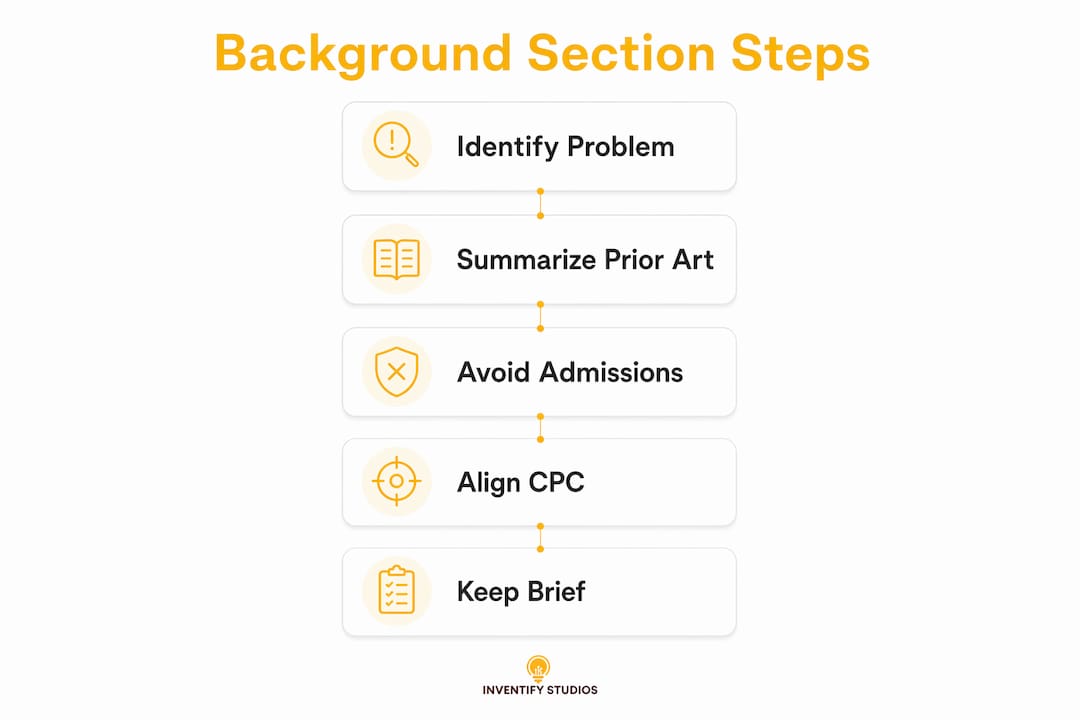
MPEP §608.01(c) describes the Background as optionally comprising two parts: Field of the Invention and Description of Related Art. Both are optional under U.S. practice, but including a brief, well-scoped version of each is standard. Knowing what a patent application contains helps you place each element correctly.
Minimal structural components:
- Field of the Invention: One sentence naming the technical area. Paraphrase a CPC definition if helpful, but keep it high-level.
- Description of Related Art / Known Problems: One to three sentences describing what prior approaches exist and why they fall short. No specific patent numbers, product names, or detailed mechanisms unless absolutely necessary.
- Need statement (optional): A single sentence identifying the gap the invention fills.
Safe sentence starters for U.S. filings:
- "The present disclosure relates to [field]."
- "Conventional [systems/methods/devices] suffer from [problem]."
- "There remains a need for [brief description of unmet need]."
- "Known approaches to [field] have been limited by [general limitation]."
Annotated minimal outline you can copy into a draft:
[Field of the Invention]
The present disclosure relates to [technical field].

[Description of Related Art]
Conventional [systems/methods] in this field are subject to [general problem or limitation].
Known approaches have not adequately addressed [specific unmet need].

[Need Statement — optional]
There remains a need for [brief, non-inventive description of the need].
Keep the entire Background under 150 words when possible. Practitioners sometimes omit it entirely when the legal liability outweighs the contextual value, which is a legitimate strategic choice.
What phrasing creates Applicant Admitted Prior Art (AAPA)?
AAPA occurs when language in your Background is treated as an admission that referenced material is prior art and relevant to your claims. Examiners can use those admissions to support obviousness rejections under 35 U.S.C. § 103, and adversaries can use them in litigation to narrow your claims.
Three categories of risky phrasing appear most often:
1. Detailed prior art descriptions Unsafe: "U.S. Patent No. 9,123,456 discloses a widget with a titanium shaft, ceramic bearing, and spring-loaded latch mechanism." Safer: "Prior widget designs have incorporated various shaft and bearing configurations, each with known durability limitations."
2. Positive admissions of advantage or desirability Unsafe: "It would be desirable to combine the low friction of ceramic bearings with the strength of titanium shafts." Safer: "Existing designs have not fully addressed the trade-off between friction reduction and structural strength."
3. Explicit motivation language Unsafe: "A person skilled in the art would recognize that combining these two known approaches would improve performance." Safer: "Known approaches have not resolved [the specific limitation]."
After KSR v. Teleflex, examiners have broader latitude to find a motivation to combine prior art elements. Any language in your Background that suggests such a motivation hands the examiner that argument on a plate.
Practical drafting strategies for U.S. patent Backgrounds

The core tactical rule: write the Background as if it will be read by an adversary looking for admissions, because during litigation, it will be.
Rules to apply at the keyboard:
- Keep it short. Two to three paragraphs is almost always enough.
- Stay factual and non-persuasive. No superlatives, no "surprisingly," no "advantageously."
- Avoid specific prior art references unless required. Paraphrase the general state of the art instead.
- Save all inventive detail for the Detailed Description. If a sentence explains how your invention works, it does not belong here.
- Align the Field statement with CPC terminology at a high level — this helps classification without over-committing to a narrow technical definition.
For CPC alignment, look up the relevant CPC subclass definition and paraphrase it at the class level. For example, if your invention falls under CPC subclass B62D (motor vehicles), your Field sentence might read: "The present disclosure relates to steering systems for motor vehicles." That is broad enough to support wide claim coverage without locking you into a narrow subclass.
Pro Tip: Before filing, have someone other than the primary drafter read the Background aloud and flag every sentence that describes what the invention does, names a specific prior art reference, or uses the words "desirable," "advantageous," or "would benefit." Those sentences are red flags.
Safe phrasing variants to keep on hand:
- "...has been limited by..." (instead of "fails to...")
- "...has not fully addressed..." (instead of "cannot...")
- "...known approaches include..." (instead of naming specific patents)
How do examiners use the Background during prosecution?
MPEP §608.01(c) sets the governing standard: the Background may include a statement of the problem in the prior art that the invention solves. Examiners use the Background to confirm classification and to understand the technical context. When they cite it during prosecution, it is almost always to support an obviousness rejection.
| Prosecution scenario | What happens | Recommended response |
|---|---|---|
| Examiner cites Background to support § 103 rejection | Background language treated as AAPA | Argue the admission is limited in scope; avoid amending Background to add new matter |
| Examiner requests Background clarification | Examiner needs field/problem context | Provide a narrow, factual clarification without expanding disclosure |
| New prior art surfaces after filing | May need to acknowledge in Background | Amend carefully; EPO guidance and U.S. practice both warn against adding new matter |
| Background contradicts claim scope | Admission narrows claim construction | Address in claim amendment or argument; do not re-draft Background to retroactively broaden |
One practical note on timing: the Background is most vulnerable at the Office Action stage. If an examiner's first rejection cites your Background, your response must argue the scope of the admission without introducing new matter. Amending the Background during prosecution is possible but carries risk — any new language must not broaden the original disclosure. For claim drafting that holds up through prosecution, the Background needs to be clean before you file.
Annotated sample Background paragraphs
Minimal safe example
"The present disclosure relates to fluid control valves. Conventional valve designs have been subject to leakage under high-pressure cycling conditions. There remains a need for valve configurations that maintain sealing integrity across extended operational cycles."
Annotation: Field sentence is broad and CPC-alignable. Problem sentence describes a known limitation without naming a specific product or patent. Need statement uses safe phrasing and does not hint at the inventive solution. Total: three sentences, zero AAPA risk.
Moderate safe example
"The present disclosure relates to wearable health monitoring devices. Existing devices in this field rely on optical sensors that are susceptible to motion artifact interference, reducing measurement accuracy during physical activity. Battery life in known designs has also been limited by continuous sensor polling. There remains a need for monitoring devices that maintain accuracy and extend operational duration under active-use conditions."
Annotation: Two problem sentences are acceptable here because they describe general, well-known limitations without citing specific products. The need statement is still non-inventive. Moderate length; acceptable risk level for most technology areas.
Unsafe example (with rewrite)
"U.S. Patent No. 8,456,789 discloses a wearable sensor using green LED optical sensing. It would be desirable to combine this optical approach with the low-power radio frequency identification (RFID) technology of U.S. Patent No. 7,654,321 to achieve both accuracy and battery efficiency."
Why it's risky: Names specific patents, describes their mechanisms, and explicitly states a motivation to combine them. After KSR, this is a ready-made § 103 rejection.
Rewrite: "Optical sensing approaches in wearable devices have been subject to accuracy limitations, while alternative sensing modalities have faced power consumption challenges. Known designs have not fully resolved both constraints simultaneously."
| Sample | Length | Risk level | Best use case |
|---|---|---|---|
| Minimal | 3 sentences | Very low | Simple mechanical or software inventions |
| Moderate | 4 sentences | Low | Complex devices with multiple known limitations |
| Unsafe | 2 sentences | Very high | Never file as written |
Pre-filing checklist: common mistakes and one-line fixes
Run through this list before every Background goes into a final application.
Most frequent errors and fixes:
- Error: Naming a specific prior art patent or product. Fix: Replace with a general description of the technology category.
- Error: Describing the invention's solution in the Background. Fix: Move the sentence to the Detailed Description verbatim.
- Error: Using "it would be desirable to combine..." Fix: Replace with "known approaches have not fully addressed..."
- Error: Claiming a prior art approach "fails" or "cannot" achieve a result. Fix: Rewrite as "has been limited by" or "has not fully addressed."
- Error: Including superlatives or marketing language ("significantly better," "dramatically improved"). Fix: Delete entirely or move to prosecution arguments.
Step-by-step pre-filing edit sequence:
- Read the Background aloud. Flag every sentence that describes what your invention does.
- Search for the words: desirable, advantageous, beneficial, would benefit, fails, cannot, superior.
- Search for patent numbers, product names, or company names.
- For each flagged item: delete, paraphrase, or move to the Detailed Description.
- Have a second reviewer (counsel or a knowledgeable colleague) confirm no inventive features remain.
Inventors should complete steps 1–3 themselves. Counsel handles steps 4–5 and signs off before filing. For inventors working without a full law firm, protecting your invention without costly support is possible with the right workflow.
Key Takeaways
The Background section's single most important function is framing the problem, not describing the solution — every drafting decision should follow from that principle.
| Point | Details |
|---|---|
| Keep it brief and factual | Two to three paragraphs maximum; no superlatives, no persuasive language. |
| AAPA is the primary risk | Overly detailed prior art descriptions can be used by examiners to support obviousness rejections. |
| Inventive detail belongs elsewhere | Move any sentence describing your invention's solution to the Detailed Description. |
| MPEP §608.01(c) governs | Field of the Invention and Description of Related Art are the two customary components under USPTO guidance. |
| Inventifystudios supports safe drafting | The platform's patentability analysis and provisional drafting tools help inventors structure Background sections without creating unintended admissions. |
The Background section is where patents quietly lose scope
Most inventors focus their energy on claims. That makes sense — claims define the legal boundary of protection. But the Background is where scope quietly erodes, often before prosecution even begins.
The conventional wisdom is that a thorough Background demonstrates expertise and builds credibility with the examiner. In practice, the opposite is true. A detailed Background that names prior art systems, explains their mechanisms, and identifies their shortcomings in precise technical terms gives an examiner a pre-built obviousness argument. You wrote it. It's in the record. It cannot be taken back without a fight.
The practitioners who draft the strongest patents tend to write the shortest Backgrounds. Two or three sentences establishing the field, one or two sentences on the general problem, and a single need statement. That's the whole section. Nothing in it describes the invention. Nothing names a specific prior art reference. Nothing suggests that combining two known elements would be a good idea.
The other underappreciated risk: Background language follows a patent into litigation. Opposing counsel will read every word looking for admissions that narrow claim construction. A sentence that seemed harmless during drafting can become the centerpiece of an invalidity argument years later. Short, factual, and non-inventive is not just safe — it is the professional standard.
Inventifystudios helps you draft a Background that won't cost you your claims
Drafting a clean Background section is harder than it looks. The line between framing a problem and disclosing a solution is easy to cross, especially when you know your invention well.
Inventifystudios gives inventors and applicants the tools to get it right before filing. The platform's automated prior art search surfaces relevant art early, so you know what the field looks like without having to name specific references in your Background. The patentability analysis flags where your invention's novel features are, helping you keep those details out of the Background and in the Detailed Description where they belong. The provisional patent drafting guidance walks you through each specification section with safe, copy-ready templates.
The result: a Background section that orients the examiner, frames the problem, and creates zero unintended admissions. Start your invention detail today and build your application on a foundation that holds up through prosecution and beyond.
Authoritative sources for further reading
- MPEP §608.01(c) — Background of the Invention: The primary USPTO authority on what the Background may include; governs examiner expectations for U.S. filings.
- 37 CFR 1.77(b) — Specification order: Sets the recommended specification structure, including the customary placement and components of the Background.
- MPEP §2129 — Admissions as Prior Art: Governs how examiner-cited admissions, including AAPA from the Background, are treated during prosecution.
- Chip Law Group — Beware of the Background Section: Practitioner warning with concrete examples of AAPA risk; useful for drafters reviewing existing applications.
- BlueIron IP — Annotated MPEP §608.01(c): Annotated practitioner commentary on when omitting or condensing the Background is a legitimate strategic choice.
- PatentPC — Role of Background Information in Patent Drafting: Practitioner blog with practical framing guidance; reinforces the problem-focused, non-inventive approach recommended here.
- USPTO Patent Application Drafting Guide (PDF): USPTO's own plain-language guide to specification structure, including Background components.
This article provides general information about U.S. patent drafting practices and is not legal advice. Confirm current USPTO requirements and your specific application strategy with a registered patent practitioner.